Alternative Choices in Psychotherapy and Autism Evaluation

Philadelphia, PA
  • Home
  • Autism Diagnosis
  • Who We Are
    • Robert Naseef, Ph.D
    • Cindy Ariel, Ph.D
    • Robert Sher, Ph.D
  • Dr. Naseef's Blog
  • Public Speaking
    • About Dr. Robert Naseef
    • Keynote Topics
    • Previous Speaking Engagements
    • Endorsements
    • Videos
    • Contact
  • Our 4 Books
  • Contact
  • Home
  • Autism Diagnosis
    • Robert Naseef, Ph.D
    • Cindy Ariel, Ph.D
    • Robert Sher, Ph.D
  • Dr. Naseef's Blog
    • About Dr. Robert Naseef
    • Keynote Topics
    • Previous Speaking Engagements
    • Endorsements
    • Videos
    • Contact
  • Our 4 Books
  • Contact

Dr. Naseef's Blog

Robert Naseef's blog provides insightful views on neurodevelopmental disorders, especially Autism Spectrum Disorders. Combining personal experience and professional insight, he explores challenges faced by individuals on the spectrum and their families. The blog highlights understanding, acceptance, and practical support, serving as a valuable resource for caregivers and professionals seeking deeper awareness and effective strategies.

  • All
  • Acceptance
  • ADHD
  • AuDHD
  • autism
  • autism parents
  • autistic adults
  • autistic children
  • Autistic children
  • civil rights
  • Diagnosis
  • disability justice
  • disability rights
  • Fathers
  • medicaid
  • racism
  • Resilience
  • scientific integrity
  • social justice

Beyond Borders: Our Human Family

Robert Naseef October 19, 2018

No matter the color of your skin, how you dress, how or if you pray, the language you speak, we are one human family. Now more than ever we need bridges not walls for our children and our families.

Click to watch the video. Arabic subtitles are available by clicking on the YouTube settings.

One response to “Beyond Borders: Our Human Family”

  1. Marie-joelle Semmikian

    Oct 20, 2018 at 8:42 am

    Edit

    Love your video! Indeed we are all one big family trying to understand and respect each other….Serving the most vulnerable brings us the opportunity to appreciate the kindness of the human being which some would like us to disbelieve…. Beautiful work Doctor!

Comment

Preparing Neurodivergent Youth for the workplace

Robert Naseef August 12, 2018

”Preparing Neurodiverse youth for the workplace” is a new educational resource now available through the Arc of Philadelphia. This resource was developed with the support of a grant from the Pennsylvania Department of Education, Bureau of Special Education (BSE)/ PaTTAN in collaboration with and the Pennsylvania Office of Vocational Rehabilitation (OVR). These materials share practical strategies and lessons learned through the “Neurodiversity in the Workplace” initiative. The goal is to better prepare neurodiverse people for rewarding and meaningful lives. You are urged to use these resources at no charge. Customize, improve, and redistribute these resources. You and your organization must not charge or sell the materials, and you must recognize the source as the Arc of Philadelphia. You are urged to participate in the conversation about improving resources for neurodiverse people. Listen to a brief introduction by Drs. Stephen Shore and Robert Naseef, lead consultants on the project.

Related posts:

https://drrobertnaseef.wordpress.com/2015/08/16/autism-and-employment-hope-on-the-horizon-2/

https://drrobertnaseef.wordpress.com/2018/06/24/neurodiversity-is-trending-a-commencement-speech/

https://drrobertnaseef.wordpress.com/2015/11/15/guy-talk-on-neurodiversity-autism-and-employment/

https://drrobertnaseef.wordpress.com/2016/06/14/autism-and-unemployment/

Click to sign up for Dr. Naseef’s monthly email newsletter.

Comment

Mindful Parenting: Moments of Joy

Robert Naseef July 30, 2018

His 5-year-old boy was not interested in playing catch with his father. Instead, he kept placing a marble at the top of his marble run and watching it go round and round to the bottom for an hour straight. His father watched with a knot in his stomach. Then he realized his son was joyful. As he told his story to the 7 other men in the room, he reflected that he couldn’t remember ever being joyful for an hour.

Although this awareness arose through the experience of having a child on the autism spectrum, experiences like this can occur for parents of typically developing children. According to Rick Hanson, Ph.D. in Hardwiring Happiness: The New Brain Science of Contentment, Calm, and Confidence, “The brain is like Velcro for negative experience and Teflon for positive ones.”

The human brain has evolved of necessity to be constantly scanning for threats to protect us. The downside is that the brain loses sight of the big picture. We spend most of our time worrying about things that might go wrong in the future and ruminating about things that have already happened. Hanson states that the way to “hardwire happiness” into the brain is to take in the good — being present to life’s tiny, joyful moments.

By observing the positive experiences with the greatest personal impact, we can train our brains to keep our eyes open for happiness and contentment and cultivate a sense of wonder.  Although all parents face challenges, parents of children with autism and other special needs often experience more anxiety, depression, guilt, and shame.

Getting in tune or in sync with your child starts with just being there and seeing the world through your child’s eyes. The child with special needs is, first of all, a child. It is through everyday routine activities that children learn and develop.  Just being there and learning to enjoy your child again is the starting point for getting back in sync. It starts with taking turns, an essential relationship skill.

  • Start with imitating or mirroring the child’s actions or vocalizations.

  • Follow your child’s lead.

  • Use facial expressions, gestures, expressive vocalizations, etc.

  • Keep taking turns increasing the number of turns that keep your child engaged.

  • Decrease whatever leads to less engagement.

In Everyday Blessings: The Inner Work of Mindful Parenting, Myla and Jon Kabat-Zinn describe the deep connection that is “available to us virtually in any moment, even in the more difficult ones, if we stay attuned both to our children and to this moment.” (p.2)  There can be moments of pure bliss, such as a child’s first steps or first words, or moments of intense frustration and pain, such as during a meltdown or aggressive behavior.  These difficult moments have the possibility of opening our minds and hearts to new learning and growth just as the father who realized that his son was blissfully playing with the marble run.

Opening to inner experience is vital for parents for we find happiness as a passing state that comes and goes as we experience everything else.  We cannot chase moments of delight any more than we can hold onto a rainbow that comes after the rain. Perhaps happiness can be understood as the side effect of living life to the fullest.

Click to sign up for Dr. Naseef’s monthly email newsletter.

Comment

Neurodiversity is trending: A commencement speech

Robert Naseef June 24, 2018

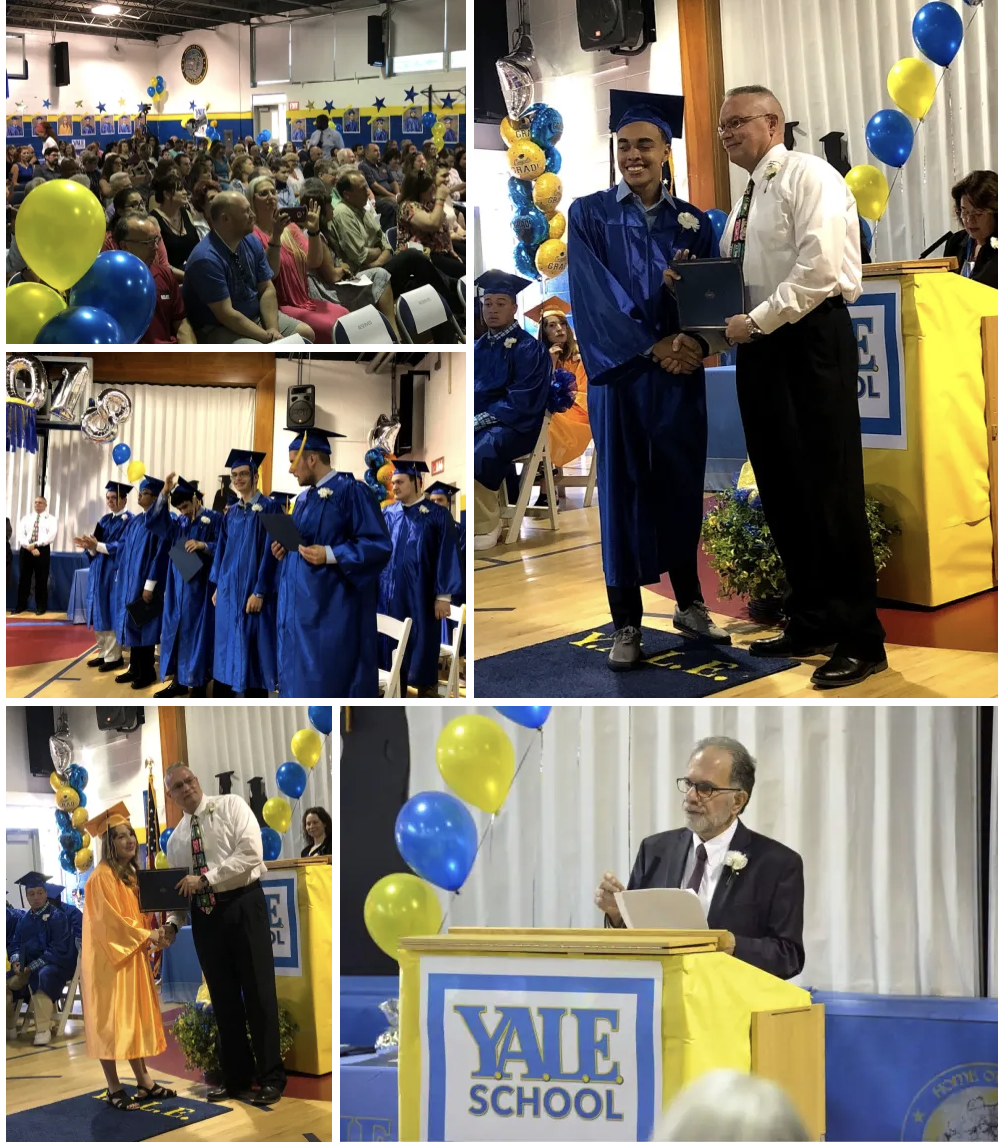
For all the graduates, what a beautiful and momentous day! Let’s enjoy it to the fullest, but let’s not forget those less fortunate than us wherever they might live on the planet we share. Please accept my heartfelt congratulations! Graduations are times of intense emotion. I’ve never been to a graduation for myself or anyone else when my eyes didn’t tear up. Graduations are times of intense emotion. (Y.A.L.E. School, Cherry Hill, N.J., June 14, 2018)

Take a moment; take a deep breath and inhale the air at the top of what must have once seemed like a mountain for you and for your families. Today marks an ending and a beginning. An ending of high school and the beginning of a transition to college or vocational training. This next chapter of your lives won’t be easy, but you have everything you need. And what would a commencement speech be like without some quotes from famous people?

You know all too well what Kermit the Frog meant when he said, “It’s not easy being green.” 

You have bounced back over and over with resilience and support and advocacy from your families. You’ve had a good education here at the Y.A.L.E. School guided by the scientific evidence how learning occurs and what makes Neurodiverse young people successful. You’ve had teachers and therapists and administrators who have worked hard and care deeply about you.

Just briefly, Neurodiversity is trending. It’s the notion that conditions like autism, dyslexia, and attention-deficit/ hyperactivity disorder (ADHD) are as naturally occurring cognitive variations with distinctive strengths that have contributed to the evolution of technology and culture rather than mere checklists of deficits and dysfunctions.” Employers, large and small as well as public and private, are realizing the benefits of a diverse workforce including people like you who are graduating today.

The concept of neurodiversity turns previously diagnosed deficits into strengths and advantages. So your different kind of mind also contains your power. For example, while individuals with ASD generally have difficulties socializing, they spend very little time socializing at work. You may have trouble getting the big picture or the gist of something, though you have an intense focus for the details. You may have difficulty with teamwork, yet are good at working independently on a project. There may be difficulties with reading comprehension, but there is a special talent for decoding.

As Temple Grandin put it, “the world needs all kinds of minds.”

Another example is that people with ADHD can excel in many occupations, such as police officers, firefighters, sales, medical professions, mechanics, construction, delivery people, etc.  Accommodations, such as extremely clear instructions, and using preferred methods of communication, are useful for all employees.

What’s good for people with different kinds of minds is usually good for everyone else.

While people with ADHD cannot maintain focus well on one thing, they can focus intensely. Also, they would rather not spend time on details, but they can get the whole picture rather quickly. You may take on too many tasks simultaneously, but have the advantage of being very energetic. You may blurt things out, but are good at brainstorming which is an advantage in teamwork. You might have little interest in non-preferred tasks, but are passionate about things you are interested in. It may be hard to get your attention, but you are good at multitasking.

As Albert Einstein put it, “Everybody is a genius. But if you judge a fish by its ability to climb a tree, it will spend its whole life believing it is stupid.”

Undoubtedly you have been hearing that the time is coming for you to advocate for yourselves. Make no mistake about it, if you don’t hand in an assignment on time, your professor will not take kindly to an email from your mom. You will be entitled to reasonable accommodations in post-secondary education or employment, but you will not be guaranteed services. You will have to speak up clearly about the accommodations you may need to be successful, such as extra time for tests or a quiet place to work, etc.

At first, you may think may think you don’t need any help, and that’s not abnormal for a new graduate, but I urge you to think and plan ahead and put in place the supports that you may need in the classroom or the workplace.

For parents, the challenge will be to stay out of your helicopter but remain available when needed. When your graduate does not want your help, try not to take it personally and realize that this is normal human development. It is how we all grow up, but it might be uncomfortable given all the effort it has taken to get to this day.

The journey of parenting is full of pushing and pulling, holding on and letting go. Speaking for myself, everything I have ever let go of had claw marks all over it!

As I have come to know, this lifelong journey that we are all on is truly an Odyssey, like the epic Greek poem, full of twists and turns as well as joys and sorrows, defeats and victories. So have a great day celebrating the victory of your graduation. Let the joy seep in and become a part of conditioning your mind for the struggles and successes that lie ahead. Use the tools that have gotten you here adapted to the challenges you will encounter.

I wish you well in love and work with safety and security every step of the way.

Click to sign up for Dr. Naseef’s monthly email newsletter.

7 responses to “Neurodiversity is trending: A commencement speech”

  1. Joan Azarva

    Jun 25, 2018 at 1:47 am

    Edit

    Perfect graduation message- you hit it out of the park! I couldn’t agree more and have heard this message at professional conferences. This viewpoint needs to be more widely promoted among the lay public.

    Like

    Reply

    1. Robert Naseef, Ph.D.

      Jun 25, 2018 at 12:53 pm

      Edit

      Thanks, Joan! Each in our community needs to carry the message forward in whatever way we can.

      Like

      Reply

  2. Steve Glazier

    Jun 25, 2018 at 12:49 pm

    Edit

    Beautiful. I am sure it was well received. Congratulations for the honor of being chosen commencement speaker.

    Like

    Reply

    1. Robert Naseef, Ph.D.

      Jun 25, 2018 at 12:51 pm

      Edit

      Thanks, Steve!

      Like

      Reply

  3. leslie ochroch

    Jul 23, 2018 at 10:03 am

    Edit

    Dr. Naseef, thank you for sharing this with us – as a parent is it heart filling and as someone dedicated to the value of neurodiversity, i really appreciate that message being explained so clearly! Thank you!! Leslie

    Like

    Reply

  4. Preparing neurodiverse youth for the workplace | Dr. Robert Naseef: Autism and Special Needs Keynote Speaker

    Aug 12, 2018 at 7:26 pm

    Edit

    […] https://drrobertnaseef.wordpress.com/2018/06/24/neurodiversity-is-trending-a-commencement-speech/ […]

    Like

    Reply

  5. From Ambiguous Loss to Acceptance with Dr. Robert Naseef | Affect Autism

    Nov 18, 2019 at 7:14 pm

    Edit

    […] Neurodiversity is Trending: A Commencement Speech […]

    Like

Comment

There’s not one way to be a man: Or father a child with autism

Robert Naseef June 3, 2018

Men find it extremely difficult to talk about a problem they cannot fix. Of course, women want to fix the problem as well but generally have an easier time talking about problems. I know about this dilemma firsthand as the father of a now adult child with autism. Learning how to talk about our child’s condition is a vital step in being able to engage actively with our families and with the professionals we turn to for help.

Our tender and heartfelt emotions are not stereotypically masculine. Most men are comfortable being grumpy, irritable, or angry. Even though the role of fathers has changed considerably in our lifetime, some degree of irritability or anger is still the traditionally acceptable emotion for men.

We need to model for our families that we can express the tender emotions inside us but typically hold in. It’s okay to let a tear roll down your cheek when watching a movie or a tv show such as “This is Us” during an emotional scene. Let’s not pretend something just got in our eye. It’s ok to admit that we are afraid, such as when you’re out with the family, and another car slams on the brakes or swerves and narrowly avoids hitting your car.

It’s exhausting to pretend to be “strong” all the time. Keeping a stiff upper lip when sad or afraid is part of the traditional boy code. The unwritten rules of how to be a real boy or a real man are conditioned into our brains from early on. A “real man” is thought to be stoic and unemotional, physically strong, and doesn’t show weakness or ask for help. Fortunately for everyone, the #MeToo and Times Up movements are challenging us to look deeper and beyond the stereotypes that serve as gender straitjackets.

A man who cooks a fancy dinner for his family, for example, shows his daughter and his son that cooking isn’t inherently female. Teaching a daughter to mow the lawn or fix a leaky faucet shows these tasks are not inherently male. Men tend to be action oriented. Being more fluid with roles can create a discussion of what it means and what it doesn’t mean to be a female or male in today’s world.

On the plus side, our action-oriented, fixing mode is how we instinctively show our love and devotion to our families. While we all do so much to earn a living, fix stuff around the house, and drive our children to activities and therapies, it is vitally important to take that extra step to listening with keen attention. Sometimes this is all that is asked for and the only action we need to take; at other times, it leads to the needed action.

Nonetheless, raising a child on the autism spectrum can bring steep challenges. It’s not unusual for a father to find himself at a loss of how to interact with a child who is different from the one he expected. However, as dads learn to deal with this sense of powerlessness, they discover what they CAN do to help their child with autism (80% of whom are boys).

Traditionally, fathers have tended to “specialize” in play, whereas mothers “specialize” in caretaking and nurturance. A father’s play with his child is typically more active and rough-and-tumble, which gives them a distinctive role in supporting their child’s development through play. However, it tends to be more difficult to engage in play with a child who has more repetitive, and less varied play, as well as other challenging behaviors.

We need to spend some time each day joining our child on the floor or at the table having fun, following our child’s lead, and building a connection. Your child with autism is still a child, and we are still men and fathers. Our sons and daughters need more from us than a roof over their heads, therapy, and school.

From my experience facilitating support groups, workshops, and counseling fathers and families several key lessons stand out:

  • Focus on what’s going right

  • Celebrate every success, large or small

  • Remember not to take things personally

  • Temper expectations

  • Learn increased levels of patience

  • Embrace what “is” versus what is “supposed to be”

As I reflect on Father’s Day, our struggle needs no longer be framed in how to be a real man. A better goal is becoming our best selves and comfortable with who we are. In that process, we can help our children and family be their best selves as well. We need a fluid way to think about gender.  The reality is that we’re all in this together, and we have a shared responsibility to make a better world for women and men along with the children in our care.

Click to sign up for Dr. Naseef’s monthly email newsletter.

7 responses to “There’s not one way to be a man: Or father a child with autism”

  1. John

    Jun 4, 2018 at 8:20 pm

    Edit

    Great article… I am one who celebrates the differences between the mother and father of an adult child of autism. You make great points which are true regardless of our circumstances with our children. Keep up the excellent work. Look forward to the next time you are in Reno.

    Like

    Reply

    1. Robert Naseef, Ph.D.

      Jun 25, 2018 at 4:24 pm

      Edit

      I look forward to Reno again and crossing paths John.

      Like

      Reply

  2. Glen Finland

    Jun 4, 2018 at 9:00 pm

    Edit

    Another thoughtful essay by Dr. Naseef. I’m sharing this one too. Happy Father’s Day to one of the best!

    Like

    Reply

    1. Robert Naseef, Ph.D.

      Jun 25, 2018 at 4:23 pm

      Edit

      Thanks for your very kind words, Glen. I hope our paths cross again.

      Like

      Reply

  3. Thomas Needham

    Jun 5, 2018 at 12:24 pm

    Edit

    Bob, thanks for reminding all of us men and fathers that we don’t all need to fit into one specific role. Being good at being ourselves is the goal to work towards. And, those key lessons? They are the best. The hardest for me are to temper my expectations and to celebrate even the small successes.
    I want to wish you and all the other dads out there a Happy Father’s Day. In so doing, I am going to share your Father’s blog with our current and alumni parents at Hill Top Prep, to provide them with some perspective and encouragement too.

    Like

    Reply

    1. Robert Naseef, Ph.D.

      Jun 25, 2018 at 4:24 pm

      Edit

      Thanks for your constant support, Tom.

      Like

      Reply

  4. Jessica Anderson

    Jun 6, 2018 at 2:05 am

    Edit

    This is all so true. I will be sharing this with the parents I work with as well as trying to remember it in my own personal journey as a parent. Thank you, and happy Father’s Day!

Comment
  • Dr. Naseef's Blog
  • Older
  • Newer
facebook youtube instagram

Alternative Choices in Psychotherapy and Autism Evaluation

Philadelphia, PA

Alternative Choices | 319 Vine Street #110, Philadelphia, PA 19106, USA

facebook youtube instagram