Alternative Choices in Psychotherapy and Autism Evaluation

Philadelphia, PA
  • Home
  • Autism Diagnosis
  • Who We Are
    • Robert Naseef, Ph.D
    • Cindy Ariel, Ph.D
    • Robert Sher, Ph.D
  • Dr. Naseef's Blog
  • Public Speaking
    • About Dr. Robert Naseef
    • Keynote Topics
    • Previous Speaking Engagements
    • Endorsements
    • Videos
    • Contact
  • Our 4 Books
  • Contact
  • Home
  • Autism Diagnosis
    • Robert Naseef, Ph.D
    • Cindy Ariel, Ph.D
    • Robert Sher, Ph.D
  • Dr. Naseef's Blog
    • About Dr. Robert Naseef
    • Keynote Topics
    • Previous Speaking Engagements
    • Endorsements
    • Videos
    • Contact
  • Our 4 Books
  • Contact

Dr. Naseef's Blog

Robert Naseef's blog provides insightful views on neurodevelopmental disorders, especially Autism Spectrum Disorders. Combining personal experience and professional insight, he explores challenges faced by individuals on the spectrum and their families. The blog highlights understanding, acceptance, and practical support, serving as a valuable resource for caregivers and professionals seeking deeper awareness and effective strategies.

  • All
  • Acceptance
  • ADHD
  • AuDHD
  • autism
  • autism parents
  • autistic adults
  • autistic children
  • Autistic children
  • civil rights
  • Diagnosis
  • disability justice
  • disability rights
  • Fathers
  • medicaid
  • racism
  • Resilience
  • scientific integrity
  • social justice

Gemini AI Image

Resilience, Resistance, and Making a Difference While Cultivating Autistic Joy and Living in Community

Robert Naseef April 9, 2026

If you’re feeling overwhelmed, you are not alone. Children are terrified of going to school. Families are being separated forcibly and deported. Peaceful protestors, including Renée Good and Alex Pretti, have been killed in the streets of Minneapolis. Warehouses are being converted into jails. Racial profiling has been made legal by the Supreme Court. Huge Medicaid cuts will begin in January 2027 that impact community-based services for autistic and otherwise neurodivergent people. There is a communal trauma that shatters our sense of safety and connection especially for the marginalized groups of our society. Dealing with our feelings while maintaining hope is our unavoidable task. I write not just as an observer or commentator, but as the father of an autistic son who lives in a group home funded entirely by Medicaid and as a practicing psychologist with a history of advocacy and caring for others.

Justice movements are inextricably intertwined. The disability rights movement in America did not just happen alongside the Civil Rights Movement; it was born from it. In the 1960s, civil rights organizer Dr. Martin Luther King, Jr., supported Cesar Chavez who was organizing migrant farm workers in California. King was assassinated while supporting striking sanitation workers in Memphis in 1968. This intersectionality was built on acts of solidarity. Disability activists took the legal strategies, moral language, and protest tactics of the Black freedom struggle and applied them to the fight for accessibility and dignity. The crucial role of Black activists in the disability rights struggle is a powerful part of this history.

During the landmark 1977 Section 504 sit-in in San Francisco, Brad Lomax, was a key organizer who engaged the Black Panther Party who provided mutual aid in the form of hot meals and supplies to the protestors, helping them sustain their 28-day occupation of a federal building. This alliance demonstrated that the fight for justice is strongest when intersecting communities recognize that their destinies are inseparable.

The neurodiversity movement draws heavily from the 1970s Disability Rights movement. Autistic self-advocates insist “Nothing About Us Without Us” in the spirit of self-determination modeled after the Civil Rights Movement’s insistence that oppressed people must be the ones to lead their own liberation. This perspective aligns autism with protected identities such as race or sexual orientation.

In 1972, Geraldo Rivera reported an exposé that documented the revolting conditions at the Willowbrook State School for children with intellectual disabilities in Staten Island, New York. The abuse and neglect revealed by Geraldo Rivera’s report led to national outcry, successful legal action, and a federally mandated network of advocacy agencies protecting the rights of people with disabilities. The nation was shocked into changing its laws by the power of free press. That freedom of the press and free speech is now being dismantled by our current administration in authoritarian fashion.

By 1975, Public Law 94-142 was passed, completely changing the landscape for people with disabilities and their families who wanted to receive an education that was equitable to that provided for people without disabilities. Parents, led by the Arc of the United States, had advocated for this law since 1950. This law established the right of every child to a free and appropriate public education in the least restrictive environment, with an Individualized Educational Program (I.E.P.) based upon specific goals and methods to achieve those goals. This law became the Individuals with Disabilities Education Act (IDEA) in 1990.

Also, in 1990, when the Americans with Disabilities Act (ADA) was stalled in Congress, dozens of activists abandoned their wheelchairs and other mobility aids and began crawling up the 83 steps of the U.S. Capitol. This direct action, known as the “Capitol Crawl,”; physically demonstrated the architectural and societal barriers they faced daily. Protester Jennifer Keelan, age 8 at that time, declared, “I’ll take all night if I have to.” The powerful images of this action, documented in the 2020 movie “Crip Camp,” helped pressure Congress to finally pass the landmark ADA legislation. Those rights to diversity, equity, and inclusion are now being gutted by the current Washington administration. People in wheelchairs, who were pushing back protesting cuts to Medicaid in the “Big Beautiful Bill,” were greeted by getting zip-tied and arrested on June 26, 2025, in the U. S. Capitol.

Having grown up in the 1960s, I was deeply impacted by the human rights and anticolonial movements led by Mahatma Ghandi, Nelson Mandela, Martin Luther King, etc. As I have deepened my knowledge of that history, it has humbled me to understand that we stand on the shoulders of those who have come before us, and we have a responsibility to those who come after us. Ghandi would advise us something to the effect of “Be the change you wish to see in the world.” So, it is up to us in the autism community of advocates, parents, families, and helping professionals to pay it forward to those who come after us to win back, protect, and advance our cause in civil and disability rights. As the Jewish poet, Emma Lazarus is quoted, “Until we are all free, none of us are free.”

In the recent past, our community has continued our proud history through the pandemic. We have proven ourselves to be resilient as families and service providers who care for children or adults with disabilities. It has never been easy, but resilience has been baked into our very beings by the challenges we have faced repeatedly. It’s been a process in which we’ve learned lots of coping skills that help us to face adversity, keep struggling, and bounce back.

The moral imperative for this struggle has connected us to each other. Facing setbacks in our own lived experience, we have practice persisting and moving forward despite our disappointments with some experiencing more adversity due to race and social class. We know how to face loneliness and alienation while finding hope and comfort in community. We must be vigilant about safety when our children, students, or clients don’t understand danger. We have learned to adjust expectations. We have learned to face our fears and regulate our emotions. We have learned to accept that which we cannot control.

In our current sociopolitical environment, staying overwhelmed and immobilized is not a good option. Parents of autistic people are telling me how deeply troubled they are by their own feelings and how powerless they are to explain to their children what they may be seeing or hearing in the news. It reminds me of a quote from Mr. Rogers: “When I was a boy and I would see scary things in the news, my mother would say to me, “Look for the helpers. You will always find people who are helping.”

In this existential and moral crisis, it takes courage to stand up to the moment speaking truth to power. We can become paralyzed, or we can take small steps on behalf of our children and their shared future. There are many things we can do to keep momentum and hope alive. For example, in Minnesota and other communities across the country, many thousands of volunteers have been delivering food to families who feel unsafe leaving their homes. This is a time to use all that we’ve learned about resilience and fortitude to persist in our values and beliefs. If you have the means, you can contribute money to food pantries. You can connect with mutual aid groups. You can exercise your free speech in protests and community meetings. You can educate yourself and others and take care of yourselves for the long haul. Our community and our families need us.

Personally, I find hope in the actions that people are taking to help. Recent examples include teams of carpenters who are actively replacing doors kicked in or broken down by federal agents. These efforts are often organized through local mutual aid networks like Stand with Minnesota, which organizes community actions and provides resources. Sometimes, it’s just everyday people doing what they believe is the right thing to do. In Philadelphia, where the history of George Washington’s slave quarters was removed from Independence National Historical Park in January by President Trump’s order, people protested repeatedly, until a court order resulted in restoring the exhibit on February 19.

Advocacy organizations such as the Autism Self Advocacy Network, the Autism Society of America, and the Arc of the United States, regularly give us alerts about important advocacy issues with detailed explanations for elected representatives. Get on their mailing lists. Take small steps regularly.

Something vital that we can all do is to celebrate and protect our autistic or disabled family members and clients in a society that regards them as different and even less than. We protect the broader community by protecting them. In this respect, celebrating and protecting autistic joy is an act of resistance. This joy can be expressed through spinning, singing, vocalizing, pacing, and authentic interaction in various forms.

When we meet autistic individuals right where they are, we can celebrate their joy. One father told me recently that when he connects with his 14-year-old daughter, “it feels like a bolt of electricity.” A mother told me that her 35-year-old son enjoys marking the calendar on the dates they will go to some of his favorite places. When a teenager holds a parent’s hand like a preschooler in the supermarket while stimming with the other hand and vocalizing, a parent can protect them and their joy by not shushing them. When a college student still sleeps with their favorite stuffed animal, a parent can support them instead of telling them they should outgrow it. When my adult son puts his head on my shoulder like a little boy, I feel his uniquely human spirit that needs protection.

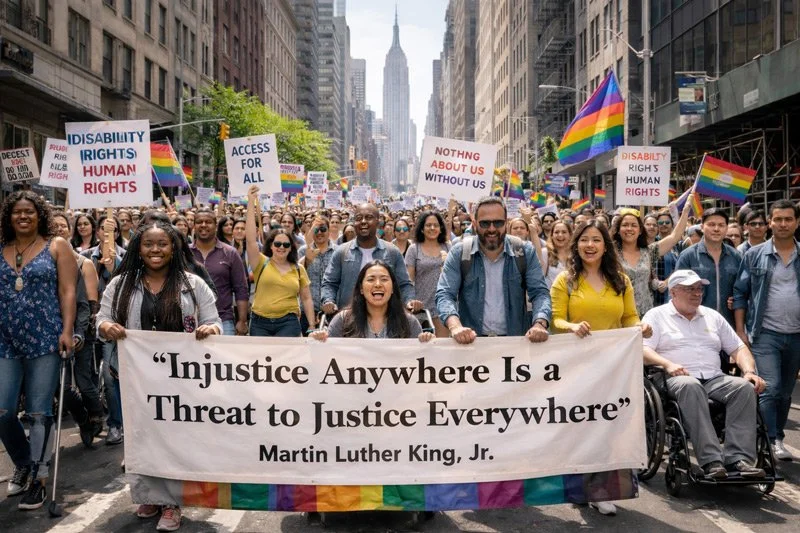
Connecting in community as we advocate for disability rights, there are countless examples that show acceptance and appreciation for the autistic experience of joy and well-being. In his “Letter from Birmingham Jail,” Martin Luther King, Jr. wrote: “Injustice anywhere is a threat to justice everywhere. We are caught in an inescapable network of mutuality, tied in a single garment of destiny.” How true today, as we strive to be a force for good while maintaining hope and faith for a better world.

Published April 3, 2026 in Autism Spectrum News

Robert Naseef, PhD, is a clinical psychologist, author, and parent of an adult son with autism. He is the co-facilitator of a fathers’ support group at Montclair University. He serves on the Panel of Professional Advisors of the Autism Society of America and blogs regularly at alternativechoices.com.

3 Comments

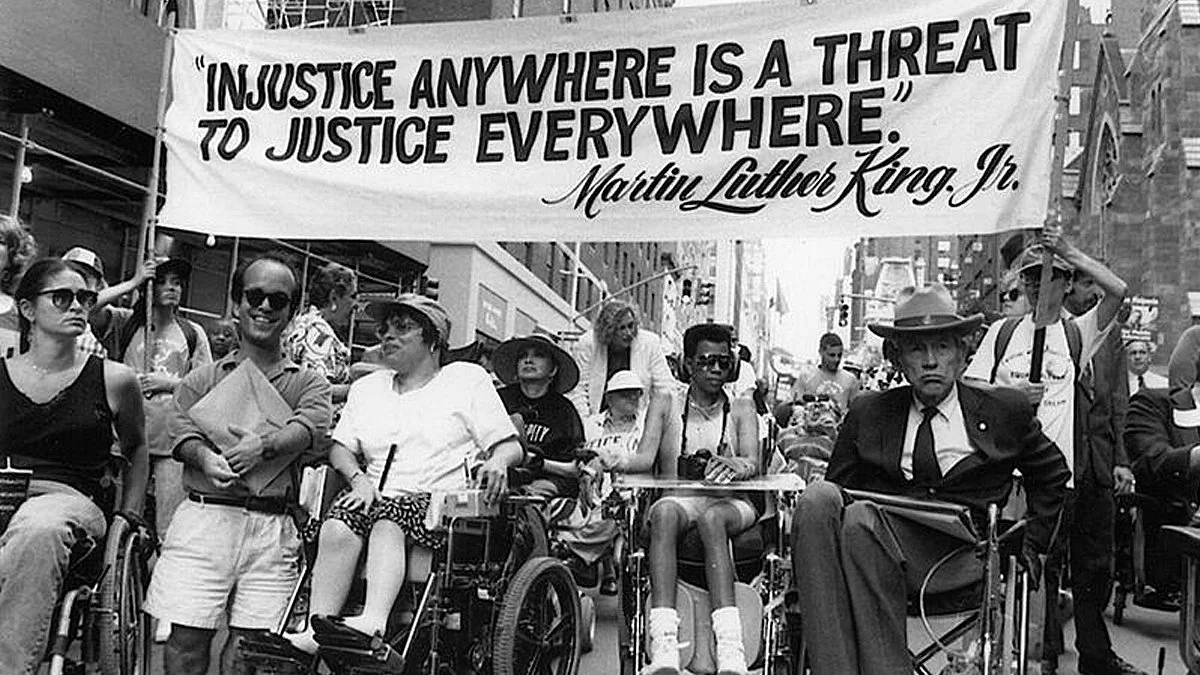
A Disability Pride Parade in New York City

Honoring MLK: Now More Than Ever

Robert Naseef January 16, 2026

As Reverend Dr. Martin Luther King, Jr. weekend is observed, there are many reasons to feel enraged, upset, anxious, and even hopeless. Although Dr. King was assassinated on April 4, 1968, it is not hard to imagine where he would stand on the issues we face as a society today. In Memphis that day, he gave a speech in support of the striking sanitation workers in which he talked about a "human rights revolution."  As our cities and communities are taken over by masked heavily armed men who are killing, injuring, and deporting people, we are facing an existential and moral crisis. There have already been hundreds of demonstrations against ICE, and more every day, drawing on his principles as we commemorate his memory. Dr. King’s memory has been sanitized so thoroughly that most recall little more than his famous “I have a dream” speech in 1963. Let’s review Dr. King’s powerful vision for justice. 

1. The real Dr. King was far more radical than most of us remember or were taught.

Beyond the fight against racial segregation, Dr. King diagnosed a deep-seated "triple prong sickness" within American society: racism, excessive materialism, and militarism. He argued that these three evils were not separate problems but inextricably linked. By 1964, MLK became one of the most prominent critics of the Vietnam War, viewing it as an "enemy of the poor." He spoke out that a nation that spent more on military aggression than on human services was facing "spiritual death." In his words, "What they truly advocate is socialism for the rich and capitalism for the poor." This vision as a radical critic of the system is usually left out.  His actual legacy is more challenging. He challenged us to not just oppose bigotry but to question the very structure of our society. 

2. Justice movements are inextricably intertwined. This sense of a shared mission was deeply felt by leaders across movements. In a telegram to Cesar Chavez who was organizing migrant farmworkers in California, Dr. King affirmed their common cause. Chavez later quoted King's words in a speech honoring him: “Our separate struggles are really one. A struggle for freedom, for dignity, and for humanity.” This intersectionality was built on tangible acts of solidarity. The disability rights movement in America did not just happen alongside the Civil Rights Movement; it was born from it. Disability activists took the legal strategies, moral language, and protest tactics of the Black freedom struggle and applied them to the fight for accessibility and dignity. The crucial role of Black activists in the disability rights struggle is a powerful part of this history. During the landmark 1977 Section 504 sit-in in San Francisco, Black Panther Party member, Brad Lomax, was a key organizer, and the Black Panther Party provided hot meals and supplies to the protestors, helping them sustain their 28-day occupation of a federal building. This alliance demonstrated that the fight for justice is strongest when intersecting communities recognize their destinies are inseparable. Autistic self-advocates insist "Nothing About Us Without Us"in the  spirit of self-determination modeled after the Civil Rights Movement’s insistence that oppressed people must be the ones to lead their own liberation.

3. Change demands disruption, not just talk. Following in the footsteps of Frederick Douglas, Dr. King understood that power rarely concedes anything without a demand. He led with a strategy  of nonviolent direct action with a clear purpose. This meant disrupting business as usual to force society to confront injustices. This principle has always been a driving force in successful movements for change. In 1990, when the Americans with Disabilities Act (ADA) was stalled in Congress, dozens of activists abandoned their wheelchairs and other mobility aids and began crawling up the 83 steps of the U.S. Capitol. This direct action, known as the "Capitol Crawl," physically demonstrated the architectural and societal barriers they faced daily. Protester Jennifer Keelan, age 8, declared, “I’ll take all night if I have to.” The powerful images of this action helped pressure Congress to finally pass the landmark ADA legislation.

4. True compassion requires restructuring society, not just charity. One of Dr. King's most profound ideas was his distinction between charity and transformative justice. King understood true compassion as a radical commitment to social reconstruction. "True compassion is more than flinging a coin to a beggar... it understands that an edifice which produces beggars needs restructuring." This deeply radical concept calls on us to move beyond individual acts of kindness and confront the political and economic systems that create and perpetuate racism, poverty, homelessness, and despair. The 504 Sit-In and the Capitol Crawl were actions designed not just to help individuals, but to rebuild a world for everyone.

5. Taking a stand is rarely safe or popular. The sanitized version of history often forgets the immense cost of moral courage. When Dr. King broke his silence on the Vietnam War, he paid a steep price. After his 1967 "Beyond Vietnam" speech, where he charged the U.S. government as "the greatest purveyor of violence in the world today," he was fiercely condemned, but he was guided by a moral imperative. Near the end of his life, he explained, "Cowardice asks the question, is it safe? Expediency asks the question, is it political? Vanity asks the question, is it popular? But conscience asks the question, is it right?” 

In conclusion, the history of the fight for social justice is complex, demanding, and intertwined. It is a story still being written now with radical critiques, disruptive actions, and profound moral courage in the face of overwhelming opposition and force. To truly honor the legacy of the Reverend Dr. Martin Luther King, Jr. is to engage in the struggles of today and join in community. In his Letter from Birmingham Jail, he wrote: "Injustice anywhere is a threat to justice everywhere. We are caught in an inescapable network of mutuality, tied in a single garment of destiny."

Click to sign up for Dr. Naseef’s monthly email newsletter, Special Families Guide.

In disability justice, disability rights, civil rights, racism, social justice, autism
2 Comments
AI-Image-Pathological-Demand-Avoidance.jpg

Autism Spectrum News, July 9, 2025 by Robert Naseef and Stephen Shore

Reframing Pathological Demand Avoidance: A Neurodiversity-Affirming Perspective

Robert Naseef September 6, 2025

Pathological Demand Avoidance (PDA) is an unnecessary and dehumanizing label. It has become frequently mentioned in the autism community as a new diagnostic label often driven by anxiety and a need for control describing adamant refusal of everyday demands, often driven by anxiety and/or need for control. (Newson et al., 2003). PDA has been widely discussed and debated which adds an unnecessary new label, discouraging families, caretakers, teachers, therapists, and others in allied fields. Focusing on Neurodiversity Affirming Supports (NAS), we incorporate theoretical overviews of PDA and its alternative terms such as Pervasive Drive for Autonomy and Rational Demand Avoidance (RDA).

For example, twelve-year-old Calishea frequently melts down when asked to clear the dishes from the table after dinner, rinse them off and put them in the dishwasher. After a brief period of whining, she slams her silverware on the table, stands up knocking over her chair backwards, and shrieks as she stomps out of the kitchen. “Get back in here” yells one or both of her parents as Calishea quickly goes to her bedroom and slams the door. Frustrated, her parents try to figure out what to do next.

Situations like this come up frequently for parents raising autistic and otherwise neurodivergent children and for their teachers in classroom settings. Increasingly, behaviors of this sort lead to a diagnosis as PDA.

Coined by Elizabeth Newson, PDA describes autistic children exhibiting obsessive resistance to everyday demands and requests (Newson et al, 2003). Although most people occasionally encounter tasks they would prefer to avoid, some individuals find any demand or request to be completely overwhelming. Since that time, it has been seen as part of the autism spectrum by many professionals and parents who are frustrated when their child refuses to do something that they are asked to. It is important to note that PDA is not an official diagnosis in the DSM-5.

PDA can be mistaken for defiance or oppositionality because it presents as ignoring or avoiding tasks that are asked of someone. Of course, ignoring, avoiding, or refusing a request from parents or teachers may cause functional difficulties. As part of the neurodiversity-affirming movement, we are concerned that the term “PDA” unnecessarily tends to pathologize and demean individuals.

There are V codes in the DSM as a set of supplementary codes used to describe factors that influence or relate to diagnoses but are not recognized diagnoses themselves. The F88 ICD-10-CM code is used to diagnose “other disorders of psychological development,” or other characteristics of psychological development in our view.

Let’s look at the example of Sensory Processing Disorder (SPD). While there is not a specific diagnosis for SPD, therapists and clinicians often use F88 to indicate symptoms related to SPD, as the code can encompass conditions like developmental agnosia and global developmental delay. It serves as a broader code documenting sensory integration issues, facilitating communication, and supporting appropriate intervention plans. Therefore, F88 functions as a catch-all, much like the PDD-NOS designation used in the past. This code provides a way for clinicians to document sensory processing difficulties when a more precise diagnosis like SPD is not available or when the individual’s symptoms overlap with other developmental differences such as autism, ADHD and intellectual disability.

New Perspectives

One perspective, Rational Demand Avoidance (RDA), is based on a cognitive-behavioral concept describing an individual’s avoidance of demands experienced as irrational, illogical, or unnecessary. This differentiates it from PDA and applies the concept to real-world applications in educational, occupational, and social contexts.

Some individuals exhibit extreme resistance to demands due to neurodevelopmental conditions such as autism, while others engage in rational demand avoidance (RDA) because they choose to avoid or delay demands based on logical or strategic reasoning. Unlike PDA, which is often associated with anxiety, RDA is characterized by deliberate, pragmatic decision-making.

Another perspective uses the same acronym to stand for Persistent Drive for Autonomy (PDA). In a society that doesn’t recognize needs, avoiding demands can seem like a rational way to manage the environment. We affirm this decidedly humanistic perspective. When the perceived cost, such as the time, effort, or emotional toll outweighs the benefits, individuals may then engage in avoidance behaviors as an adaptive strategy as described below.

While most of these strategies are implemented at the moment of avoidance, other strategies focus on prevention of the challenging behavior before it starts. For example, in a social context children and adults may refuse to engage in social situations involving mostly small talk that provide little personal, professional or relational benefit when taking part in groups that do not line up with their interests. A possible strategy could be to alter expectations that require neurodivergent individuals to attend meetings that do not interest them.

Another example could occur when there is sensory overload such as Bright lights, large groups, noisy restaurants, and overcrowded situations. Some possible supports include dimming lights, noise cancelling headphones, attending noisy crowded events online where possible, shopping late at night, eating at restaurants outside of traditional mealtimes.

In an educational context, a student, whether in grade school or in college, may refuse to complete assignments when they have already demonstrated mastery of the subject. Instead, they pursue their passions. Unfortunately, they wind up with a negative grade. It’s important to note that time in school can be exhausting, leading to meltdowns or shutdowns when additional work is required at home. Supportive strategies might be to individualize homework to the student by adjusting the workload, providing movement breaks, and focusing on quality over quantity.

These new perspectives reflect an adaptive approach to tasks and obligations which may lead to conflict, particularly in rigid environments such as schools or traditional workplaces. Understanding these new perspectives on demand avoidance can foster more flexible expectations respecting the individual differences and autonomy of neurodivergent individuals.

Persistent Drive for Autonomy is characterized by an intense need for autonomy and control over an individual’s environment often resisting external demands or expectations (Milton, 2017). Unlike oppositional defiance, this behavior is not primarily motivated by defiance or rebellion but by an intrinsic need for self-determination (O’Nions et al., 2014).

Specifically, this profile is characterized by resistance to external control, resulting in avoidance behaviors. For example, an office worker insists on taking a break away from their desk at 10:00 AM as a result of a difficult phone session with an irate, unreasonable customer, but break time is not until 10:30. The office worker frequently takes breaks off schedule based on their emotional or sensory needs.

Conclusion

Unfortunately, the neurodiverse-affirming perspective described in this article has not been widely adopted. This approach is still in the beginning stages which we hope will become the standard of care for neurodivergent children and adults through their lifespan. Further research is needed to refine diagnostic criteria and intervention strategies tailored to the needs of individuals. Critical gaps remain in its conceptualization, assessment, and treatment. Further empirical and qualitative work is needed to develop evidence-based interventions.

This view emphasizes the underlying motivation of seeking control in the relatively unpredictable environment the neurodivergent individual experiences as contrasted to the typical world rather than simply being pathological, diseased, disordered, or unhealthy in their avoidance of demands. The concept of a persistent drive for autonomy expands the understanding of demand avoidance beyond neurodevelopmental conditions and highlights the importance of autonomy as a core psychological need.

Robert Naseef, PhD

Stephen Shore, EdD

Robert Naseef, PhD, is a clinical psychologist, author, and parent of an adult son with autism. He is the co-facilitator of a fathers’ support group. He serves on numerous boards and blogs regularly at drrobertnaseef.com.

Stephen Shore, EdD, is an autistic individual who is a clinical associate professor of special education at Adelphi University. He combines his personal, practical, and academic experiences to promote fulfilling and productive lives for autistic people as the rule rather than the exception. Serving on numerous autism-related boards, his website is www.drstephenshore.com.

References

American Psychiatric Association (APA) (2022). Diagnostic and statistical manual of mental disorders (5th ed., text rev.). Washington, DC: American Psychiatric Association.

Milton, D. (2017). “A Mismatch of Salience: Exploring the Nature of Pathological Demand Avoidance from a Neurodiversity Perspective.” Good Autism Practice, 18(1), 14-23.

Newson, E., Le Maréchal, K., & David, C. (2003). “Pathological demand avoidance syndrome: A necessary distinction within the pervasive developmental disorders.” Archives of Disease in Childhood, 88(7), 595-600.

O’Nions, E., Viding, E., Happé, F., & Creswell, C. (2014). “Pathological demand avoidance: Exploring the behavioural profile.” Autism, 18(5), 538-544.

Click to sign up for Dr. Naseef’s monthly newsletter

Comment
microphone

Autism Leaders United in Call for Action Following Roundtable in Washington D.C.

Robert Naseef May 15, 2025

RFK Jr. did not show up to listen to us. We all learned from each other and are more committed to action. The Autism Community is more diverse in every way and more united than ever. I am deeply grateful for a voice at that table.

Read More
In medicaid, autistic adults Tags autism acceptance, autism community, disabilityrights, social justice, neurodiversity
Comment

How Autism Teaches Us About Fatherhood: Insights with Dr. Robert Naseef

Robert Naseef May 4, 2025

I had a great conversation with Kenneth Braswell about fatherhood and autism and came away deeply appreciative of all the work he does with and for dads. Kenneth remarked, “Parenting a child with autism challenges every part of your heart—and strengthens it.” I shared my lived experiences and insights about resilience, acceptance, and the unique role of fathers in raising autistic children. In this powerful episode of “I Am Dad Podcast”, Kenneth Braswell explored how autism impacts family life, what fathers uniquely bring to the parenting journey, and how acceptance and resilience grow hand-in-hand. Through his probing questions, I was able to draw from the 4 decades since my son,Tariq, was dignosed. I reflected upon personal and professional experience—as a psychologist and a father. None of this advice and emotional wisdom came easily for families walking this path.

Our conversation was honest, hopeful, and deeply human. In a broad sense, Autism has a lot to teach us abiut fatherhood as Kenneth captioned this conversation. I am grateful for the time spent with Kenneth Braswell, and I hope that our paths will pass again.

Click to sign up for Dr. Naseef’s monthly email newsletter, Special Families Guide.

In Fathers, Autistic children, Resilience, Acceptance
2 Comments
  • Dr. Naseef's Blog
  • Older
  • Newer
facebook youtube instagram

Alternative Choices in Psychotherapy and Autism Evaluation

Philadelphia, PA

Alternative Choices | 319 Vine Street #110, Philadelphia, PA 19106, USA

facebook youtube instagram