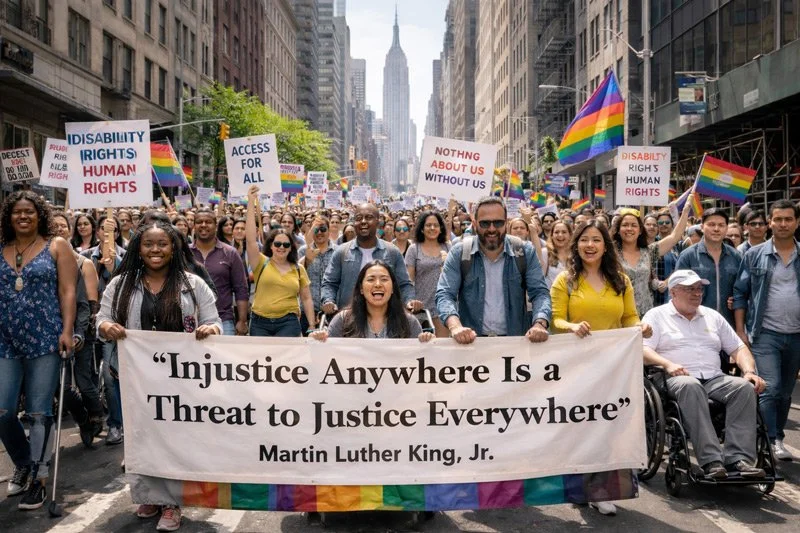
If you’re feeling overwhelmed, you are not alone. Children are terrified of going to school. Families are being separated forcibly and deported. Peaceful protestors, including Renée Good and Alex Pretti, have been killed in the streets of Minneapolis. Warehouses are being converted into jails. Racial profiling has been made legal by the Supreme Court. Huge Medicaid cuts will begin in January 2027 that impact community-based services for autistic and otherwise neurodivergent people. There is a communal trauma that shatters our sense of safety and connection especially for the marginalized groups of our society. Dealing with our feelings while maintaining hope is our unavoidable task. I write not just as an observer or commentator, but as the father of an autistic son who lives in a group home funded entirely by Medicaid and as a practicing psychologist with a history of advocacy and caring for others.
Justice movements are inextricably intertwined. The disability rights movement in America did not just happen alongside the Civil Rights Movement; it was born from it. In the 1960s, civil rights organizer Dr. Martin Luther King, Jr., supported Cesar Chavez who was organizing migrant farm workers in California. King was assassinated while supporting striking sanitation workers in Memphis in 1968. This intersectionality was built on acts of solidarity. Disability activists took the legal strategies, moral language, and protest tactics of the Black freedom struggle and applied them to the fight for accessibility and dignity. The crucial role of Black activists in the disability rights struggle is a powerful part of this history.
During the landmark 1977 Section 504 sit-in in San Francisco, Brad Lomax, was a key organizer who engaged the Black Panther Party who provided mutual aid in the form of hot meals and supplies to the protestors, helping them sustain their 28-day occupation of a federal building. This alliance demonstrated that the fight for justice is strongest when intersecting communities recognize that their destinies are inseparable.
The neurodiversity movement draws heavily from the 1970s Disability Rights movement. Autistic self-advocates insist “Nothing About Us Without Us” in the spirit of self-determination modeled after the Civil Rights Movement’s insistence that oppressed people must be the ones to lead their own liberation. This perspective aligns autism with protected identities such as race or sexual orientation.
In 1972, Geraldo Rivera reported an exposé that documented the revolting conditions at the Willowbrook State School for children with intellectual disabilities in Staten Island, New York. The abuse and neglect revealed by Geraldo Rivera’s report led to national outcry, successful legal action, and a federally mandated network of advocacy agencies protecting the rights of people with disabilities. The nation was shocked into changing its laws by the power of free press. That freedom of the press and free speech is now being dismantled by our current administration in authoritarian fashion.
By 1975, Public Law 94-142 was passed, completely changing the landscape for people with disabilities and their families who wanted to receive an education that was equitable to that provided for people without disabilities. Parents, led by the Arc of the United States, had advocated for this law since 1950. This law established the right of every child to a free and appropriate public education in the least restrictive environment, with an Individualized Educational Program (I.E.P.) based upon specific goals and methods to achieve those goals. This law became the Individuals with Disabilities Education Act (IDEA) in 1990.
Also, in 1990, when the Americans with Disabilities Act (ADA) was stalled in Congress, dozens of activists abandoned their wheelchairs and other mobility aids and began crawling up the 83 steps of the U.S. Capitol. This direct action, known as the “Capitol Crawl,”; physically demonstrated the architectural and societal barriers they faced daily. Protester Jennifer Keelan, age 8 at that time, declared, “I’ll take all night if I have to.” The powerful images of this action, documented in the 2020 movie “Crip Camp,” helped pressure Congress to finally pass the landmark ADA legislation. Those rights to diversity, equity, and inclusion are now being gutted by the current Washington administration. People in wheelchairs, who were pushing back protesting cuts to Medicaid in the “Big Beautiful Bill,” were greeted by getting zip-tied and arrested on June 26, 2025, in the U. S. Capitol.
Having grown up in the 1960s, I was deeply impacted by the human rights and anticolonial movements led by Mahatma Ghandi, Nelson Mandela, Martin Luther King, etc. As I have deepened my knowledge of that history, it has humbled me to understand that we stand on the shoulders of those who have come before us, and we have a responsibility to those who come after us. Ghandi would advise us something to the effect of “Be the change you wish to see in the world.” So, it is up to us in the autism community of advocates, parents, families, and helping professionals to pay it forward to those who come after us to win back, protect, and advance our cause in civil and disability rights. As the Jewish poet, Emma Lazarus is quoted, “Until we are all free, none of us are free.”
In the recent past, our community has continued our proud history through the pandemic. We have proven ourselves to be resilient as families and service providers who care for children or adults with disabilities. It has never been easy, but resilience has been baked into our very beings by the challenges we have faced repeatedly. It’s been a process in which we’ve learned lots of coping skills that help us to face adversity, keep struggling, and bounce back.
The moral imperative for this struggle has connected us to each other. Facing setbacks in our own lived experience, we have practice persisting and moving forward despite our disappointments with some experiencing more adversity due to race and social class. We know how to face loneliness and alienation while finding hope and comfort in community. We must be vigilant about safety when our children, students, or clients don’t understand danger. We have learned to adjust expectations. We have learned to face our fears and regulate our emotions. We have learned to accept that which we cannot control.
In our current sociopolitical environment, staying overwhelmed and immobilized is not a good option. Parents of autistic people are telling me how deeply troubled they are by their own feelings and how powerless they are to explain to their children what they may be seeing or hearing in the news. It reminds me of a quote from Mr. Rogers: “When I was a boy and I would see scary things in the news, my mother would say to me, “Look for the helpers. You will always find people who are helping.”
In this existential and moral crisis, it takes courage to stand up to the moment speaking truth to power. We can become paralyzed, or we can take small steps on behalf of our children and their shared future. There are many things we can do to keep momentum and hope alive. For example, in Minnesota and other communities across the country, many thousands of volunteers have been delivering food to families who feel unsafe leaving their homes. This is a time to use all that we’ve learned about resilience and fortitude to persist in our values and beliefs. If you have the means, you can contribute money to food pantries. You can connect with mutual aid groups. You can exercise your free speech in protests and community meetings. You can educate yourself and others and take care of yourselves for the long haul. Our community and our families need us.
Personally, I find hope in the actions that people are taking to help. Recent examples include teams of carpenters who are actively replacing doors kicked in or broken down by federal agents. These efforts are often organized through local mutual aid networks like Stand with Minnesota, which organizes community actions and provides resources. Sometimes, it’s just everyday people doing what they believe is the right thing to do. In Philadelphia, where the history of George Washington’s slave quarters was removed from Independence National Historical Park in January by President Trump’s order, people protested repeatedly, until a court order resulted in restoring the exhibit on February 19.
Advocacy organizations such as the Autism Self Advocacy Network, the Autism Society of America, and the Arc of the United States, regularly give us alerts about important advocacy issues with detailed explanations for elected representatives. Get on their mailing lists. Take small steps regularly.
Something vital that we can all do is to celebrate and protect our autistic or disabled family members and clients in a society that regards them as different and even less than. We protect the broader community by protecting them. In this respect, celebrating and protecting autistic joy is an act of resistance. This joy can be expressed through spinning, singing, vocalizing, pacing, and authentic interaction in various forms.
When we meet autistic individuals right where they are, we can celebrate their joy. One father told me recently that when he connects with his 14-year-old daughter, “it feels like a bolt of electricity.” A mother told me that her 35-year-old son enjoys marking the calendar on the dates they will go to some of his favorite places. When a teenager holds a parent’s hand like a preschooler in the supermarket while stimming with the other hand and vocalizing, a parent can protect them and their joy by not shushing them. When a college student still sleeps with their favorite stuffed animal, a parent can support them instead of telling them they should outgrow it. When my adult son puts his head on my shoulder like a little boy, I feel his uniquely human spirit that needs protection.
Connecting in community as we advocate for disability rights, there are countless examples that show acceptance and appreciation for the autistic experience of joy and well-being. In his “Letter from Birmingham Jail,” Martin Luther King, Jr. wrote: “Injustice anywhere is a threat to justice everywhere. We are caught in an inescapable network of mutuality, tied in a single garment of destiny.” How true today, as we strive to be a force for good while maintaining hope and faith for a better world.
Published April 3, 2026 in Autism Spectrum News
Robert Naseef, PhD, is a clinical psychologist, author, and parent of an adult son with autism. He is the co-facilitator of a fathers’ support group at Montclair University. He serves on the Panel of Professional Advisors of the Autism Society of America and blogs regularly at alternativechoices.com.