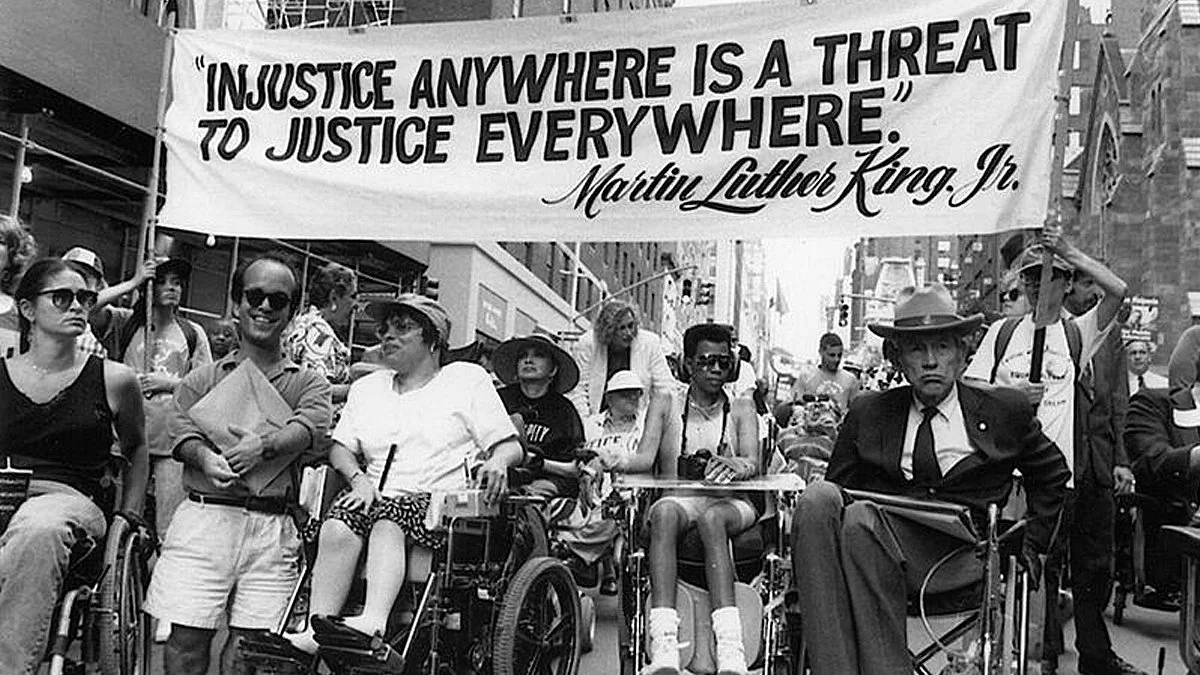
As Reverend Dr. Martin Luther King, Jr. weekend is observed, there are many reasons to feel enraged, upset, anxious, and even hopeless. Although Dr. King was assassinated on April 4, 1968, it is not hard to imagine where he would stand on the issues we face as a society today. In Memphis that day, he gave a speech in support of the striking sanitation workers in which he talked about a "human rights revolution." As our cities and communities are taken over by masked heavily armed men who are killing, injuring, and deporting people, we are facing an existential and moral crisis. There have already been hundreds of demonstrations against ICE, and more every day, drawing on his principles as we commemorate his memory. Dr. King’s memory has been sanitized so thoroughly that most recall little more than his famous “I have a dream” speech in 1963. Let’s review Dr. King’s powerful vision for justice.
1. The real Dr. King was far more radical than most of us remember or were taught.
Beyond the fight against racial segregation, Dr. King diagnosed a deep-seated "triple prong sickness" within American society: racism, excessive materialism, and militarism. He argued that these three evils were not separate problems but inextricably linked. By 1964, MLK became one of the most prominent critics of the Vietnam War, viewing it as an "enemy of the poor." He spoke out that a nation that spent more on military aggression than on human services was facing "spiritual death." In his words, "What they truly advocate is socialism for the rich and capitalism for the poor." This vision as a radical critic of the system is usually left out. His actual legacy is more challenging. He challenged us to not just oppose bigotry but to question the very structure of our society.
2. Justice movements are inextricably intertwined. This sense of a shared mission was deeply felt by leaders across movements. In a telegram to Cesar Chavez who was organizing migrant farmworkers in California, Dr. King affirmed their common cause. Chavez later quoted King's words in a speech honoring him: “Our separate struggles are really one. A struggle for freedom, for dignity, and for humanity.” This intersectionality was built on tangible acts of solidarity. The disability rights movement in America did not just happen alongside the Civil Rights Movement; it was born from it. Disability activists took the legal strategies, moral language, and protest tactics of the Black freedom struggle and applied them to the fight for accessibility and dignity. The crucial role of Black activists in the disability rights struggle is a powerful part of this history. During the landmark 1977 Section 504 sit-in in San Francisco, Black Panther Party member, Brad Lomax, was a key organizer, and the Black Panther Party provided hot meals and supplies to the protestors, helping them sustain their 28-day occupation of a federal building. This alliance demonstrated that the fight for justice is strongest when intersecting communities recognize their destinies are inseparable. Autistic self-advocates insist "Nothing About Us Without Us"in the spirit of self-determination modeled after the Civil Rights Movement’s insistence that oppressed people must be the ones to lead their own liberation.
3. Change demands disruption, not just talk. Following in the footsteps of Frederick Douglas, Dr. King understood that power rarely concedes anything without a demand. He led with a strategy of nonviolent direct action with a clear purpose. This meant disrupting business as usual to force society to confront injustices. This principle has always been a driving force in successful movements for change. In 1990, when the Americans with Disabilities Act (ADA) was stalled in Congress, dozens of activists abandoned their wheelchairs and other mobility aids and began crawling up the 83 steps of the U.S. Capitol. This direct action, known as the "Capitol Crawl," physically demonstrated the architectural and societal barriers they faced daily. Protester Jennifer Keelan, age 8, declared, “I’ll take all night if I have to.” The powerful images of this action helped pressure Congress to finally pass the landmark ADA legislation.
4. True compassion requires restructuring society, not just charity. One of Dr. King's most profound ideas was his distinction between charity and transformative justice. King understood true compassion as a radical commitment to social reconstruction. "True compassion is more than flinging a coin to a beggar... it understands that an edifice which produces beggars needs restructuring." This deeply radical concept calls on us to move beyond individual acts of kindness and confront the political and economic systems that create and perpetuate racism, poverty, homelessness, and despair. The 504 Sit-In and the Capitol Crawl were actions designed not just to help individuals, but to rebuild a world for everyone.
5. Taking a stand is rarely safe or popular. The sanitized version of history often forgets the immense cost of moral courage. When Dr. King broke his silence on the Vietnam War, he paid a steep price. After his 1967 "Beyond Vietnam" speech, where he charged the U.S. government as "the greatest purveyor of violence in the world today," he was fiercely condemned, but he was guided by a moral imperative. Near the end of his life, he explained, "Cowardice asks the question, is it safe? Expediency asks the question, is it political? Vanity asks the question, is it popular? But conscience asks the question, is it right?”
In conclusion, the history of the fight for social justice is complex, demanding, and intertwined. It is a story still being written now with radical critiques, disruptive actions, and profound moral courage in the face of overwhelming opposition and force. To truly honor the legacy of the Reverend Dr. Martin Luther King, Jr. is to engage in the struggles of today and join in community. In his Letter from Birmingham Jail, he wrote: "Injustice anywhere is a threat to justice everywhere. We are caught in an inescapable network of mutuality, tied in a single garment of destiny."