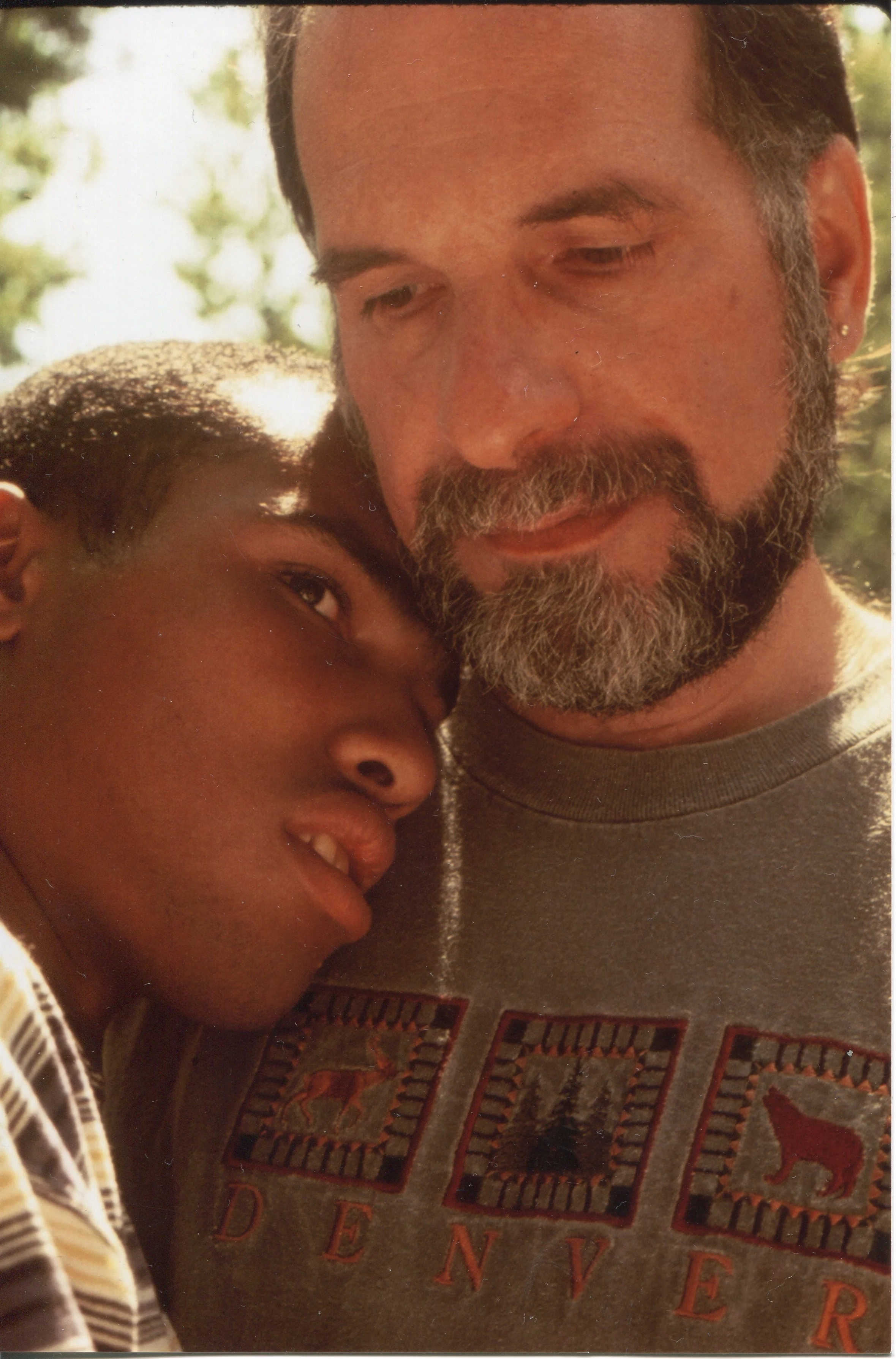
Robert Naseef, PhD and Stephen Shore, EdD

Stephen, Tariq, and Robert
We are writing to explain why we do not need more labels to describe autism. We, the authors, became acquainted with each other in 1996 through a common mentor, Stanley Klein, the editor of Exceptional Parent Magazine when we each published our first books: Beyond the Wall: Personal Experiences with autism and Asperger Syndrome by Stephen M. Shore and Special Children, Challenged Parents: The Struggles and Rewards of Raising a Child With a Disability by Robert A. Naseef . Right away we began helping each other understand what it is like to be Autistic as well as the challenges and rewards of family life. From his autistic perspective Stephen has helped Robert understand things about his son Tariq. Robert’s 44 year old son Tariq is unable to verbalize. Robert helps Stephen understand the family perspective when a child is diagnosed and the family lives on the spectrum.
We have presented our perspectives which have been well received nationally and internationally within the autism community over the past 20 years. For example, In 2019, we served as lead consultants to the Arc of Philadelphia and SAP’s “autism at Work” program which involved collaboration with the Pennsylvania Department of Education and the Bureau of Vocational Rehabilitation to develop the social skills curriculum, “Preparing Neurodiverse Youth for the Workplace.” In 2022, upon the request of the Qatar Foundation, we completed and delivered a “train the trainer” curriculum to enable Qatar to find meaningful employment for their neurodivergent population. Whereas the concept of neurodiversity has great potential for unifying the autism community, it has unfortunately become a source of division.
Neurodiversity is the concept that there are large variations in how human brains perceive, process, and respond to the world around them. The human race is incredibly neurodiverse. Neurodivergent individuals differ more than the typical norm. Neurodivergent conditions include autism, ADHD, dyslexia, synesthesia, dyscalculia, Down syndrome, and others.
Along with neurodiversity there has been a transition from a model of deficit, disorder, and disability to a more social construction focusing on strengths and making needed environmental and other adjustments to promote abilities to shine through. While espousing abilities based ways of considering autism and other neurodivergent conditions, it is also important to hold space for the very real disabling challenges that can come with being autistic or having other neurodivergent conditions in our society.
Relatedly, we have recently been frequently chatting about the push for a new diagnosis of profound autism. Unfortunately, the autism community has been riddled with splits and controversies historically. None of the splits have helped Autistic people or their families, so we are proposing a common bond about the need to unite.
Stephen: All autistic people are bound together by differences in social communication, highly focused interests and greater variations in sensory processing than the non autistic population. For example, perhaps my communication difference displays as perseverating on a topic for way too long whereas Tariq has significant challenges in using spoken word at all. We are bound together by diverse differences in communication. Tariq and I have highly focused interests and activities running deeper than the hobbies of most non-autistic individuals. For example, I can spend hours on Youtube listening to the same piece of music as interpreted by different performers, conductors, and instrumental ensembles. Tariq can fiddle with inanimate objects for endless hours.
Robert: Stephen and Tariq are both autistic and couldn’t be more different. Stephen has high level language, and I can have the high-level philosophical talks I imagined having with Tariq. Tariq has little to no spoken language, so we can have no conversations at all. Yet when I come to see each of them, I get that big deep pressure autistic hug. Both Stephen and Tariq enjoy long walks with me when we are together. Tariq by holding my hand and silently pulling me around, Stephen by walking beside me and talking about what we are experiencing as two friends and colleagues.
Stephen: Tariq and I share autistic characteristics and identities. Our commonalities are irreducible. I am Tariq and Tariq is me.
As opposed to more levels and splits, we propose personalized services for all Autistics ranging from those having advanced education and fulfilling employment to more challenged individuals who are nonspeaking, or have medical or mental health conditions. Whenever we are both in the Philadelphia area, we enjoy visiting and accepting Tariq just as he is.
We espouse, teach, and apply the neurodiversity model because it doesn’t pathologize and focus disproportionately on what the person struggles with. In contrast, it focuses on what the individual can do. It also recognizes that genetic or other kinds of biological variation are intrinsic to people’s identity. So their sense of self and personhood should be given equal respect alongside any other form of diversity, such as gender.
Robert, I recently had the privilege to narrate a day in Tariq’s life for the National Disability Rights Organization. One of my autistic clients was overjoyed to meet Tariq for the first time on the video.
Despite clear alternatives, some prominent voices, including parents of autistic children with high support needs, in the autism world are continuing to push for a new category which they are calling “profound autism.” They are completely ignoring autistic voices. The Autism Self Advocacy Network , ASAN, “has continually opposed attempts to split autism into multiple diagnoses. These attempts will not improve services for autistic people and are largely based on the desire to segregate autistic people with the most significant cognitive disabilities and support needs.” The Autism Science Foundation is funding research to support this change. This also seems to be supported by the April 2023 Centers for Disease Control report that 27% of people diagnosed with autism meet the criteria for “profound autism”.
The label of “profound autism” does not add to understanding the complex support needs of the heterogeneous group of individuals with both autism and intellectual disabilities. All functioning labels, including “severe autism” and “high functioning autism” actually harm people. Self-advocates and parents such as Shannon Des Roches Rosa explain with great clarity the view that profound autism is segregation not progress.
Because autism is a lifelong neurodevelopmental condition that causes significant social, communication and behavioral challenges, suicide is a leading cause of death in autistic people. In addition to elevated levels of various mental health problems, autistic people are at a significantly increased risk of suicidality (suicidal ideation, suicide plans, suicide attempts, and death by suicide) compared to non-autistic people. An influential study of diagnosed autistic adults found 66% had experienced suicidal ideation, which was nine times higher than the general population, and 35% had a suicide plan or had made a suicide attempt .
So, what’s the alternative to labels?
What parents need at the time of diagnosis and throughout their child’s development is clear guidance on which interventions and strategies can best serve their autistic child as an individual to have the best possible quality of life in the community. The Lancet Commission report actually called for “dramatic action over the next five years to bring desperately needed support and services to autistic children and adults and their families worldwide based upon their individual differences, strengths, and needs.” It also mentioned that most autism research to date has been on white males.
Females and BIPOC have never been adequately included in research samples. Now there is a real opportunity to change that. A new report from the CDC shows autism prevalence in the United States is continuing to rise, now at 1 to 36, as race and sex gaps contract. Non-white children have been identified as autistic at slightly higher rates than white children for the first time. This is good news that early screening and identification have helped narrow racial disparities in the early identification of autism. Closing the gap on access to services is the next imposing challenge. As opposed to focusing on labels, researchers can focus on how autism shows up differently in females and Black, Hispanic, and Asian or Pacific Islander children. These differences will inform clinicians, schools and parents on which interventions and services will be most effective for given individuals. Funding varies considerably according to the local school districts which significantly impacts children and families by race and class.
The humanistic concept of neurodiversity has shown great promise in uniting people from all walks of life across race, class, ability, diagnosis, etc. Having spoken to conferences around the country and internationally, we rarely meet parents or self-advocates who are suggesting a new category for individuals with high support needs. Rather, questions tend to focus on “How do I help my child?” or “How do I get help for myself?” Like many other groups pushing for change and social movements, the autism community has had numerous splits and factions. We don’t need more of that.
We do meet some parent advocates who feel left behind as the stereotype of autism in the mainstream media has shifted from the non-speaking to the self-advocates. Major autism conferences tend to feature keynote speakers who represent one portion of the autism spectrum who give hope to the families of newly diagnosed individuals. However, many self-advocates clearly speak towards the support needs for the entire spectrum. They speak as strongly for themselves as they do for those who are unable to speak. According to two prominent self advocates, John Elder Robison and Dena Gassner, There is no epidemic of autism. It’s an epidemic of need.
We believe that new labels will further stigmatize autistic individuals. We need to unite as a diverse, heterogeneous community of autistic people, parents, professionals, and researchers. Let’s go forward by focusing on every autistic person’s right to access individualized, person-centered services that identify specific needs and personalized support for using their strengths for success in their communities.
Stephen: I have been teaching the 4 A’s of Autism as a way of addressing this epidemic of need.
Step 1, Awareness, has been a focus of the autism community for over 40 years; from where autism was considered a rare psychiatric condition caused by poor parenting with a prevalence rate of 5 in 10,000. With a current rate of almost 3% we are better at recognizing autism at home, in education, at work, and in the community. Additionally, increasing numbers of autistic people are seeing autistic characteristics in themselves and often verify their suspicions with formal diagnostic procedures. Awareness builds a solid foundation for the following work.
Step 2, Acceptance, is where parents, teachers, and others turn away from considering autism as a series of deficits, disorder, and disability towards an abilities based model that accepts the person for who they are. An example is the difference between holding out a favored activity as a reinforcer to motivate a student to learn mathematics to incorporating that focused interest into learning the subject.
Step 3, Appreciation, is where autistic people are valued for our contributions to society. Examples of valuing autistic people include large IT companies actively seeking autistic employees because they know a certain subset of autistic people can engage in computerized geekery at levels beyond most others to the individuals needing support in most aspects of life who thoroughly enjoy the process of folding laundry with perfect creases faster and with more enthusiasm then their typical colleagues. All employers large and small can benefit from the skills and abilities autistic people bring to the workplace.
Step 4, Action is the process of making the three previous A’s work as a protocol for empowering autistic people to lead fulfilling and productive lives as the rule rather than the exception.
We believe that new labels will further stigmatize autistic individuals. We need to unite as a diverse, heterogeneous community of autistic people, parents, professionals, and researchers. Our needs vary from the low support needs of millions who can speak for themselves to millions who need round the clock care, like Robert’s son.
As we go to press with this article, the Autism CARES Act of 2024 if authorized would provide $2 billion in funding over five years to advance autism research, services, and training. Splitting our community in today’s toxic political environment endangers the passage of this bill which would have tragic results.
Let’s go forward by focusing on every autistic person’s right to access individualized, person-centered services that identify specific needs and personalized support for using their strengths for success in their communities.
Robert: This is a social justice issue and a human right.
Click to sign up for Dr. Naseef’s monthly email newsletter, Special Families Guide.