Scroll down for Spanish.
On this first week of the new year, our Center is reviving the Friday Focus to share our sadness and dismay at the violence at the Capitol this week. We condemn the actions of domestic terrorists. We uphold civil actions of peaceful protest that have allowed our democracy to continually advance on the long arc journey to justice. We stand together against violence with conviction, understanding, discourse, and resolve to work for justice and for peace.
We understand that our children are watching. Many adults may wonder whether they should shield or protect children from the violent events of this week. In developmentally appropriate ways, we encourage adults to educate children on our political system in general, and of the attempted insurrection of January 6th in particular. We believe democracy survives because of awareness, peaceful critique, and civic action.
We also know that being exposed to violence can be scary for children. We have included guidance below to assist you through a conversation with children about the violence at the Capitol.
Let us be clear-eyed and honest with our children about our collective societal failures and political faults, especially the continual restriction to the freedom guaranteed by our Constitution for so many. But let us also be hopeful that the foundation of positive relationships and healthy development that our work supports will provide the base on which we build the democracy that reflects our highest ideals of life, liberty and the pursuit of happiness for all.
Ten Tips for Talking with Children about the Violence at the Capitol
1. If you feel uncertain about how to start this conversation with children, practice with adults first. Notice the parts of the conversation where you might need assistance and ask for support from other adults.
2.Ask children what they know and what they have heard. Listen to the child's story and follow the child's lead. Use simple language and correct any misunderstood accounts. Tell a child what they need to know, not all that you know.
3.Be there and be calm. Monitor your own emotion and tone of voice. Pay attention to your gestures, affect, and voice because children pay special attention to these ways of communicating. Children scan the faces, voices and movements of others to discern safety. Your presence, voice, words, soft and loving touches, provide each child with the best ways of feeling safe.
4. Share your feelings. It is okay and important for children to know that the adults in their lives have the same feelings when bad things happen. Ask about their feelings. Often children will experience and express their feelings through their body states. Ask them "what” and “where" they feel (e.g. head, tummy, chest, neck, etc.) as well as "how" do they feel.
5.Recognize that there are some feelings that we can only share and cannot fix: Children need us to be there with and for them at such times. It's appropriate to both not have an answer and be with the children in their sadness and confusion.
6. While we encourage telling children about the events of January 6th, monitor repeated exposure to images and reports of the events. Provide enough exposure to inform, but not frighten.
7. If children do get scared, remember the 3R's of security: Relationships, Routines and Restoration. Highlight relationships with familiar and consistent caregivers, family and friends. Protect and increase routines that are familiar and normalizing.
8. Provide structure and communicate safety: Uncertainty is the province of adulthood. While we as adults may feel unsure of the state of our democracy, we must always let children know that we will take care of them and protect them.
9.A sense of mastery can help alleviate fear and uncertainty. Encourage your children to get involved in a community or service program such as collecting items for a food bank, making a call to their Congressperson, signing a petition or writing a letter to someone in local government about something that they would like to help change in their community.
10. Remember to take care of yourself: We have all been living with the collective stres
s of Covid-19 and political uncertainty for a l-o-n-g time. Yet, we know that if the adults in a child's life are overwhelmed, overstressed and overtired, it will be more difficult for the child to feel safe, secure and stable. Prioritize the cultivation of the "ABC's" of self-care: awareness, balance and connection, in your own life.
(Costa, G. & Mulcahy, K, 2021)
Montclair State University | Center for Autism and Early Childhood Mental Health, 147 Clove Road, Little Falls, NJ 07424
SPOTLIGHT ON STORIES!
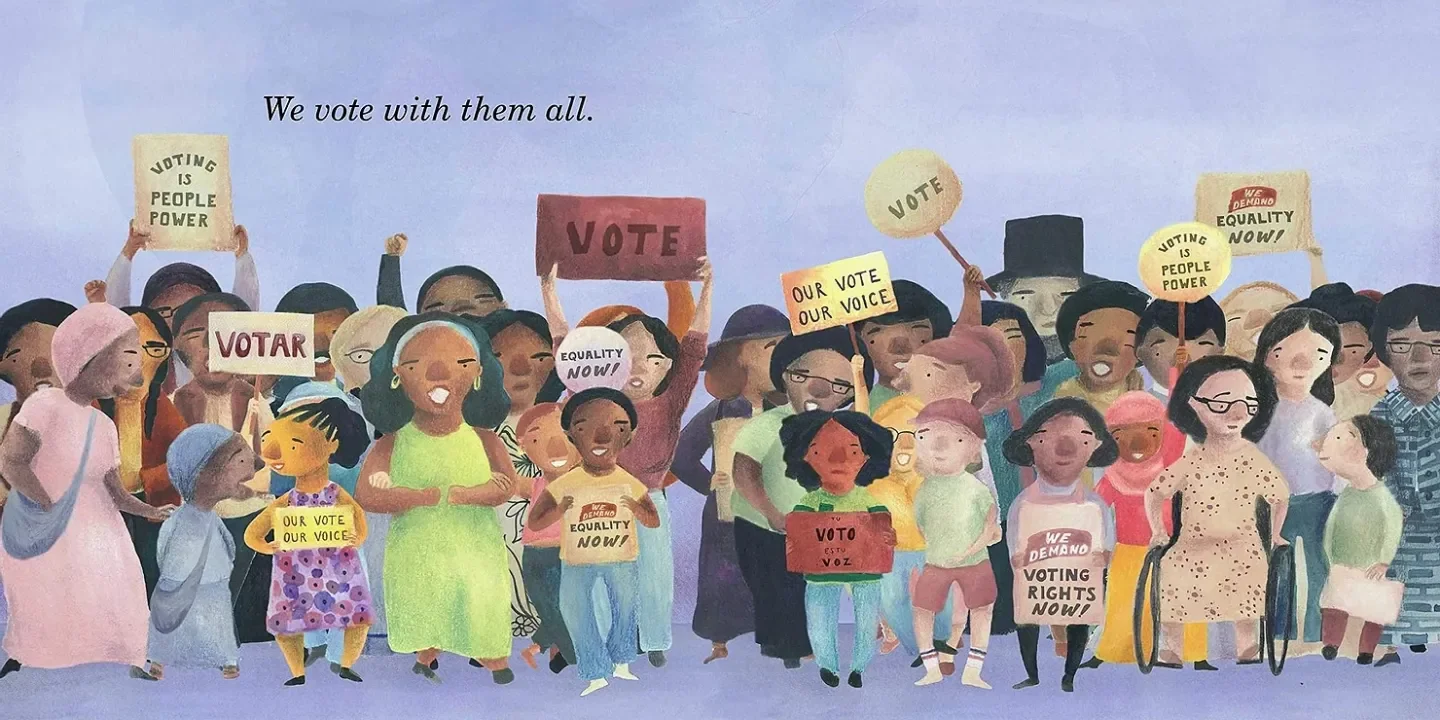
We know that stories can help communicate difficult topics to children. We love this list of books about elections, politics and civic engagement from the Helping Kids Rise organization. See if you have any in your library!
Books about Elections, Politics and Civic Engagement
Enfoque: Hablar con los niños pequeños sobre la violencia en las noticias
En esta primera semana del nuevo año, nuestro Centro está reviviendo
el Enfoque del Viernes para compartir nuestra tristeza y consternación
ante la violencia en el Capitolio esta semana. Condenamos las acciones
de los terroristas domésticos. Defendemos las acciones civiles de
protesta pacífica que han permitido que nuestra democracia avance
continuamente en el largo camino hacia la justicia. Nos unimos contra
la violencia con convicción, comprensión, discurso y determinación
para trabajar por la justicia y por la paz.
Entendemos que nuestros hijos están observando. Muchos adultos
pueden preguntarse si deben defender o proteger a los niños de los
eventos violentos de esta semana. De manera apropiada y de acuerdo
al nivel de desarrollo, alentamos a los adultos a educar a los niños
sobre nuestro sistema político en general, y sobre el intento de
insurrección del 6 de enero en particular. Creemos que la democracia
sobrevive con la conciencia, la crítica pacífica y la acción cívica.
También sabemos que estar expuestos a la violencia puede ser
aterrador para los niños. Hemos incluido a continuación la guía para
ayudarle a conversar con los niños sobre la violencia en el Capitolio.
Seamos claros y honestos con nuestros hijos sobre nuestros fracasos
sociales colectivos y nuestras faltas políticas, especialmente la continua
restricción a la libertad garantizada por nuestra Constitución para
tantos. Pero también tengamos la esperanza de que los cimientos de
las relaciones positivas y el desarrollo saludable que nuestro trabajo
apoya proporcionarán la base sobre la que construimos una
democracia que refleja nuestros más altos ideales de vida, libertad y la
búsqueda de la felicidad para todos.
Diez consejos para hablar con niños sobre la violencia en
el Capitolio
1. Si no está seguro de cómo iniciar esta conversación con los niños(as), practique
primero con los adultos. Observe las partes de la conversación en las que podría necesitar
ayuda y pida apoyo a otros adultos.
2. Pregunte a los niños(as) qué saben y qué han escuchado. Escuche la historia del niño(a)
y siga su liderazgo. Use un lenguaje sencillo y corrija cualquier malentendido. Dígale al
niño(a) lo que necesita saber, no todo lo que usted sabe.
3. Estar allí y estar tranquilo. Monitorea sus propias emociones y tono de voz. Prestar
atención a sus gestos, afecto y voz porque los niños(as) prestan atención especial a estas
formas de comunicación. Los niños(as) escanean los rostros, voces y movimientos de los
demás para discernir la seguridad. Su presencia, voz, palabras, toques suaves y amorosos,
proporcionan a cada niño(a) las mejores maneras de sentirse seguro.
4. Comparta sus sentimientos. Está bien y es importante que los niños(as) sepan que los
adultos en sus vidas tienen los mismos sentimientos cuando suceden cosas malas.
Pregúnteles por sus sentimientos. A menudo los niños experimentarán y expresarán sus
sentimientos a través de sus estados corporales. Pregúnteles "qué" y "dónde" se sienten
(por ejemplo, cabeza, barriga, pecho, cuello, etc.), así como "cómo" se sienten.
5.Reconocer que hay algunos sentimientos que sólo podemos compartir y no podemos
arreglar: Los niños(as) necesitan que estemos allí con y para ellos(as) en esos momentos.
Es apropiado no tener una respuesta y estar con los niños(as) en su tristeza y confusión.
6. Si bien animamos a contar a los niños(as) acerca de los acontecimientos del 6 de
enero, supervise la exposición repetida a imágenes e informes de los acontecimientos.
Proporcione suficiente exposición para informar, pero no asustar.
7. Si los niños(as) se asustan, recuerde las 3R de seguridad: Relaciones, Rutinas y
Restauración. Resalte las relaciones con cuidadores, familiares y amigos consistentes.
Proteger y aumentar las rutinas que son familiares y normalizadoras.
8. Proporcionar estructura y comunicar la seguridad: La incertidumbre pertenece a la
edad adulta. Si bien nosotros, como adultos, podemos sentirnos inseguros del estado de
nuestra democracia, siempre debemos hacer saber a los niños(as) que los cuidaremos y
los protegeremos.
9.Un sentido de maestría puede ayudar a aliviar el miedo y la incertidumbre. Anime a sus
hijos(as) a involucrarse en su comunidad o en un programa de servicio, como recoger
artículos para un banco de alimentos, hacer una llamada a su congresista, firmar una
petición o escribir una carta a alguien en el gobierno local sobre algo que les gustaría
ayudar a cambiar en su comunidad.
10. Recuerde cuidarse: Todos hemos estado viviendo con el estrés colectivo de Covid-19
y la incertidumbre política por un tiempo l-a-r-g-o. Sin embargo, sabemos que si los
adultos en la vida de un niño(a) están abrumados, sobrecargados y cansados, será más
difícil para el niño(a) sentirse seguro, protegido y estable. Priorizar el cultivo de las "ABC'
del cuidado personal: conciencia, equilibrio y conexión, en tu propia vida.
(Costa, G. & Mulcahy, K, 2021)
SPOTLIGHT ON STORIES!
Sabemos que las historias pueden ayudar a comunicar temas difíciles a los niños. Nos
encanta esta lista de libros sobre elecciones, política y compromiso cívico de la
organización Helping Kids Rise. ¡A ver si tienes alguno en tu biblioteca!
Books about Elections, Politics and Civic Engagement