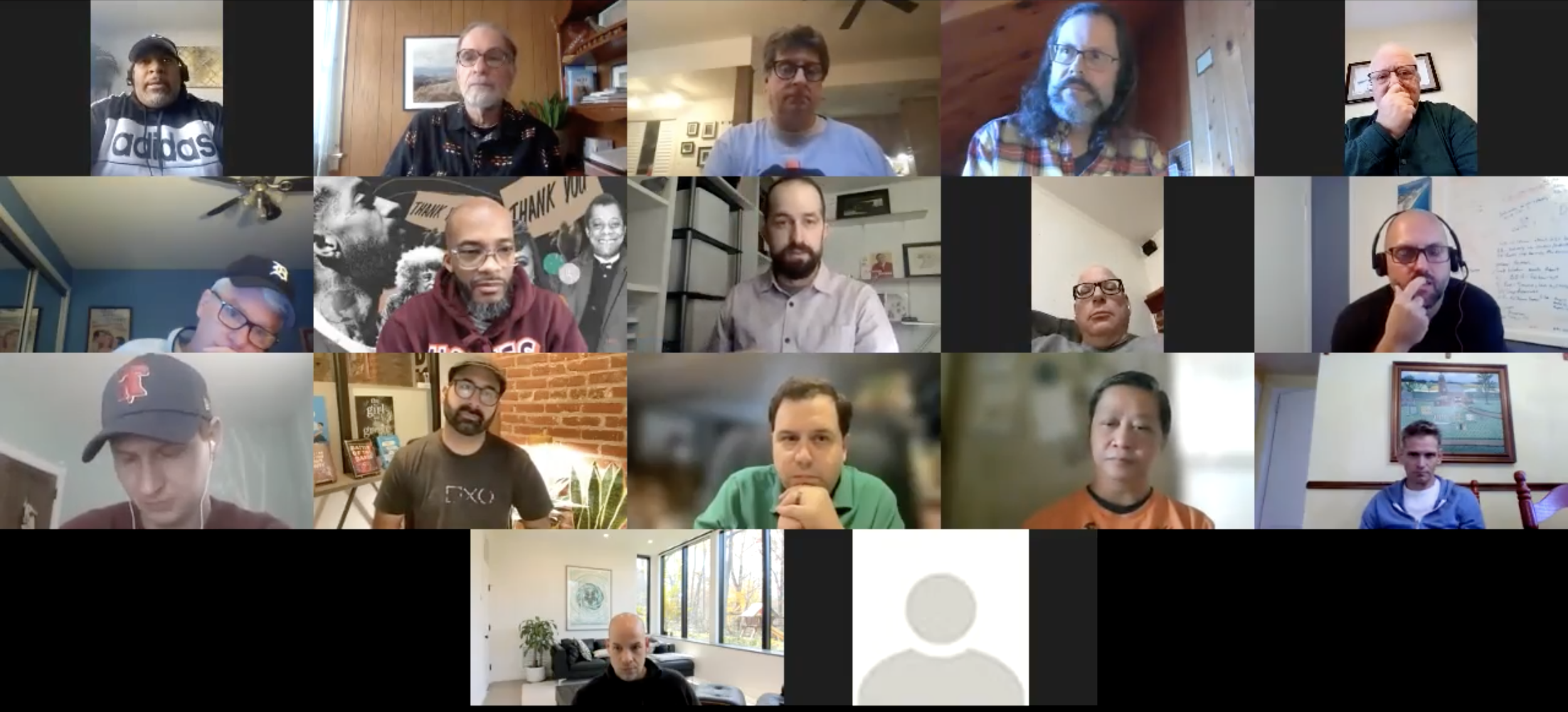
Our November meeting started out with some opening comments about acceptance. One father was brutally honest as he disclosed still trying to accept his young son’s autism diagnosis. What can we change? What can we live with? What do we have to live with? Can we live without shutting down or being in a consistently ugly mood because we're guys?
Acceptance was described as living in relative peace with life as it is, not what we want it to be. In the diverse and safe space that we have built for over two years, guys were invited to share things that they may not have felt brave enough or safe enough to say out loud about acceptance.
The father of a child who is minimally verbal shared how overwhelming it seems to think of his son's future as an adult. He has found that going day-by-day - sometimes moment-by-moment - is the best. Another father, whose wife passed away, shared how exhausting it is as a single parent of his 28-year-old autistic son. Another man accepts and loves his child, but he confesses that it’s hard not to compare his experience to the neurotypical development (and privileges) he sees played out in his extended family and community.
Then the father of a 7-year-old who was diagnosed at 3 admitted, “I’m pretty angry at the world!” He became tearful and couldn’t say any more. We wondered what his tears would say if they could speak.
The Zoom room was temporarily quiet and reflective leading to an outpouring of support:
“You’re allowed to be angry”
“Angry about what? What's under the surface?”
“I'm beyond anger. I am really pissed. My 17-year-old is in residential care and the last three months have been the worst of my life.”
The men of older children, who are teens or adults, were able to share that it's OK if it feels like the anger is over, and it's OK if it's not over. As facilitators, we stressed that anger comes and goes at different volumes and with thoughts of injustice. Some older fathers shared that there are difficulties in accepting the aging process in their bodies that caused them to slow down and makes it hard to keep up with their children. While anger can be energizing and helpful to get out of a rut, as another pointed out, it's not always constructive. Gratitude for what is going right is useful, but not easy to access, because our default as men is to go with the anger.
A Black father from a southern state shared how difficult it was for him to wrap his mind around the diagnosis of his two children, because they are described as looking so normal but are so different. It was painful to hear people say, “They're so cute. They’re fine. You just worry too much!” After he got through his denial with the help of couples’ therapy, he was still angry about how difficult it was to get the proper services for his children.
Once again, the room got quiet for a few moments, and again there was an outpouring of support. There was emotional solidarity and lots of advice-giving which we couldn’t resist as men. Overall, our time together was full of the inspiring fire of raw male emotion. There was gratitude expressed for hearing these emotions expressed in a way that many had never experienced elsewhere. One father concluded that, “I’m positive to a fault. It’s OK to be angry and ask, about what?”
Another wisely pointed out, “It’s easier to be mad than sad.” Others called our time in this supportive space as a highlight of their week because the emotional honesty was a revelation of buried feelings. It takes courage to listen and peel back the layers underneath the anger. What else is there?
If you are able, join us this Saturday, December 18, at 11:00 AM Eastern. If that doesn't work for you, we will be available on the 3rd Saturday of every month. For information about meetings contact AutismInstitute@drexel.edu
Stay safe, and peace!
Michael and Robert
P.S. If you weren’t there and haven’t seen it yet, check out our Father’s Day Live event on YouTube.