Humanism honors the whole person and the uniqueness of the individual. Barry Prizant, Ph.D. and Tom Fields-Meyer do that exquisitely in Uniquely Human: A Different Way of Seeing Autism (2015). This is a ground-breaking and superb book. Instead of fixing a person by eliminating symptoms, Dr. Prizant provides a compelling alternative view by seeking to understand the individual’s experience and what underlies the behavior.
Barry told viewers that he has been a therapist for 46 years ever since he worked as a teenager at a summer camp for children with special needs. He described himself as “captured by the kids.” He fell in love living and caring for them and developed an interest. Along the way, he discovered his own innate ability to connect with the beautiful children and families who are so often misunderstood. Intellectually he studied child development and became a speech therapist and then a speech and language pathologist.
Prizant describes the full range of the autism spectrum from the most challenged to the most capable. The panel was interested in his perspective on echolalia as a developmental stage in language development. Echolalia—the tendency of a person with autism to repeat words, phrases, or whole sentences over and over. This often frustrates parents as well as professionals, and for years the common wisdom has been to try to stop echolalia.
Prizant helps us understand that children with autism communicate in all sorts of ways. Sometimes their repetitions are a way of rehearsing what they are going to say or indicating that they understand. When we listen carefully and observe the context, it becomes clear that individuals with autism are using language for the same purposes as everyone else but in a different way. They may be experiencing or reliving excitement, pain, anxiety or joy. By listening carefully, it often becomes clear what the child is trying to communicate.
Barry Prizant’s advice is first to acknowledge that it might be driving you crazy and then moved to understanding the deep meaning and the possible function. Taking this long view enables parents and professionals to use other approaches such as visual learning. There are resources available at http://barryprizant.com/resources/downloads/echolalia-articles/.
Kaveh Adel, Peter F., and Michael Hannon related their current experiences dealing with echolalia and the progress that their children are making. Professor of Special Education, Stephen Shore shared how his speech development included echolalia. Stephen shared his parents telling him “you don’t have to do what parrots do.” Understanding that echolalia serves a purpose can help families and professionals to be patient. There is often progress toward more typical conversation. Some children echo less as they mature, but under stress they may tend to revert to echoing.
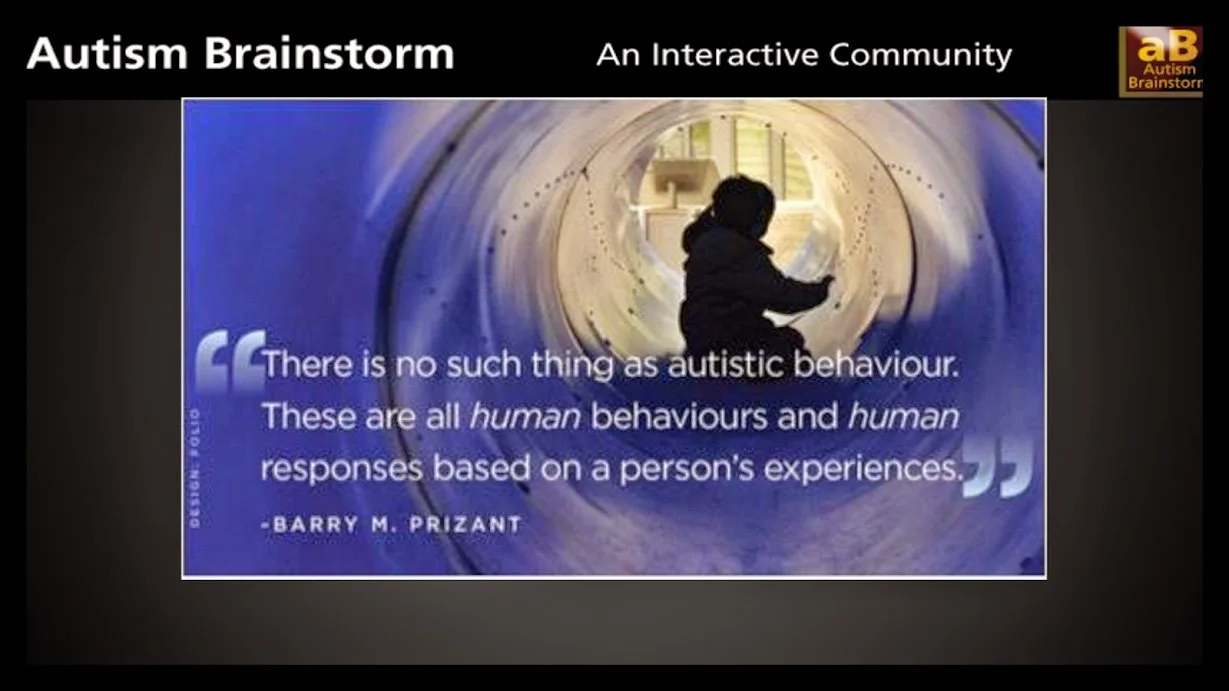
The most refreshing part of our conversation was the concept that there is no such thing as autistic behavior. Rather there are challenges of behavior which we must first learn to understand and let go of the focus on getting rid of the behavior. Don’t most of us at times bore others by repeating ourselves? How about overloading emotionally and melting down? The question arose as to when behaviors tip the balance from neurotypical to the autism spectrum. Barry explained very clearly that the diagnosis is appropriate when the pattern meets to DSM five criteria and requires services to support the person to adapt to the challenges of life.
The panel also discussed special interests which are often seen as obsessions, but Prizant reframed them as enthusiasms. Therapist used to try to extinguish these enthusiasms. Boundaries and limits are certainly needed with many enthusiasms; however the contemporary approach is to use that interest to build relationships to foster development and develop skills.
Another key concept, often overlooked, is the challenges and emotional regulation emotional regulation that are virtually universal among people living with autism. Downloads of useful information about the SCERTS Model which has an emphasis on emotional regulation is available at http://barryprizant.com/resources/downloads/scerts-articles/.
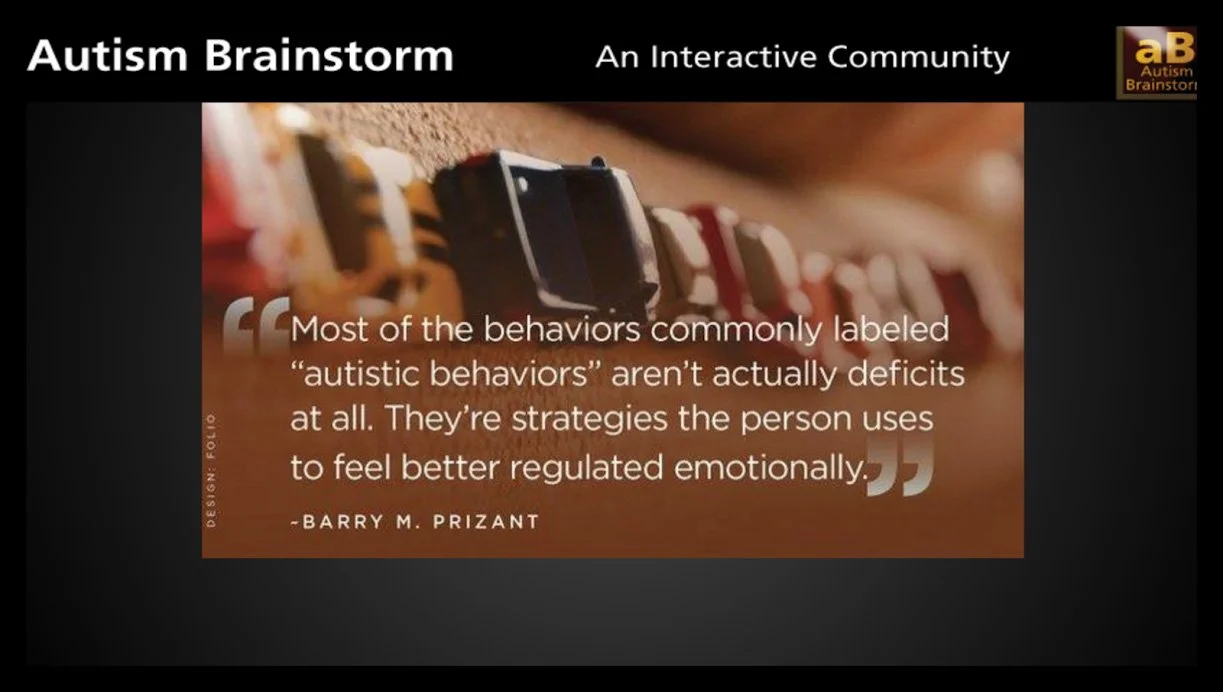
Uniquely Human moves its readers to the powerful need to understand autism as a different way of being human as opposed to fixing. Our job according to Barry Prizant is to understand the child and develop trust with the child to foster development. As self- advocate Stephen Shore commented, “Uniquely Human” gets at the heart of autism and what it’s like to be on the spectrum.”
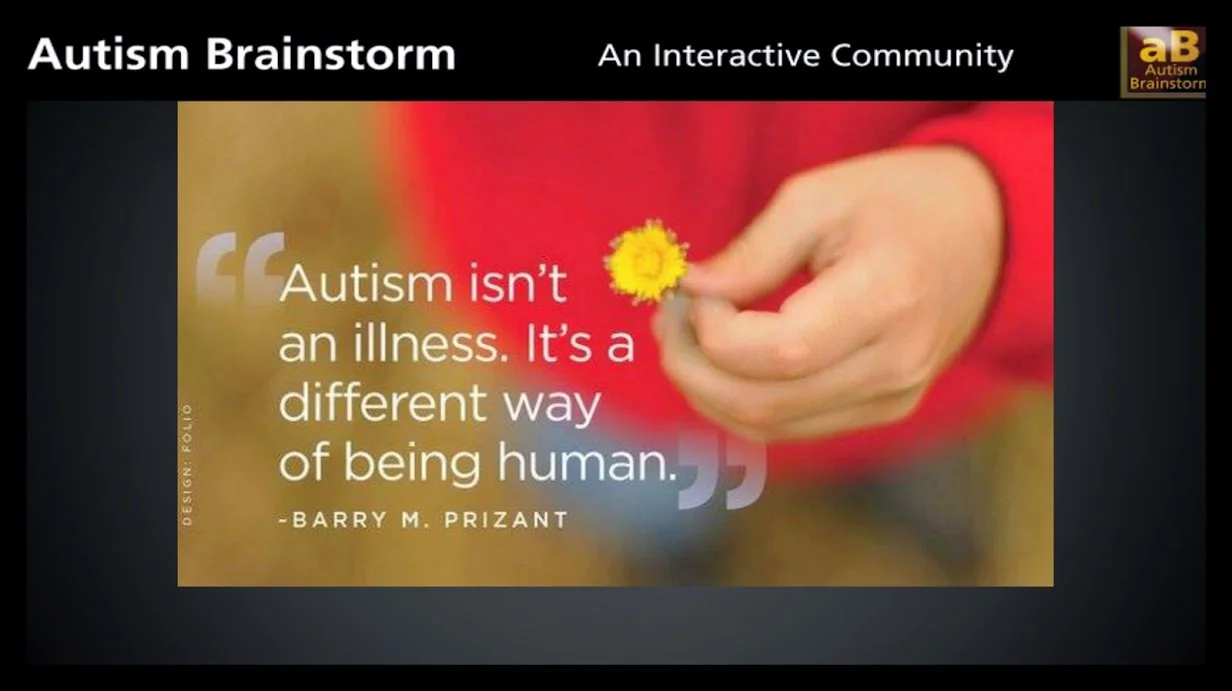
Focusing on autism as part of humanity embraces the diversity of the human condition. As a parent, I wish I had this book 30 years ago when my son was 5. As a psychologist, it is now the first book I recommend to parents when they have a child diagnosed with autism.
Click to sign up for Dr. Naseef’s monthly email newsletter.
4 responses to “Autism is a different way of being human”
Lucille yeager
I am so interested in this approach. I have an autistic grandson who will be 28. And has gotten progressively worse since he was diagnosed. He has been living primarily with his mom who has decided that he will never be able to earn a living. He is prompted in an angry tone to do what he expected to do and I do not observe any other interactions between he and his brother and sister. My son and his wife are divorced.
Like
I appreciate hearing from you, Lucille. As a family member, especially as a grandmom, it is painful to watch a situation like this. Learning about this approach might not fix the problem, but it may help you be the best grandmom you can be.
Like
Corinne Hartsough
As a parent with an High Functioning Autistic Adult son, I can share with you that of our 22 years with our son, my husband and I have grieved together, and separately, for what our son may or may not become. I’ve found over the years that we don’t identify our grieving, when it comes to the crushing of our dreams. We are so busy with the day to day. It leaves us bitter, especially when the medical and educational communities have been so ill equipped to cope with our pain or our children’s challenges. On the up side, as time has past, I’ve grown to accept the role as advocate and that our life as aging parents will be different than we planned. Bob Naseef’s sharings and his encouraging staff have helped me to realize that it will be different, but o.k.. Life isn’t always what we expect it to be, but good things can develop in those changes too. In the beginning (20 years ago) friends told me “we have to fight”. Now I realize that we have to learn and adapt. And I’m still learning, but I’m not sad or angry anymore. Best wishes.
Like
I really appreciate your comment Corrine. It warms my heart to hear of your journey as a parent, and being able to make a difference in the lives of families is the reason we do with we do in our psychology practice at Alternative Choices.
Like