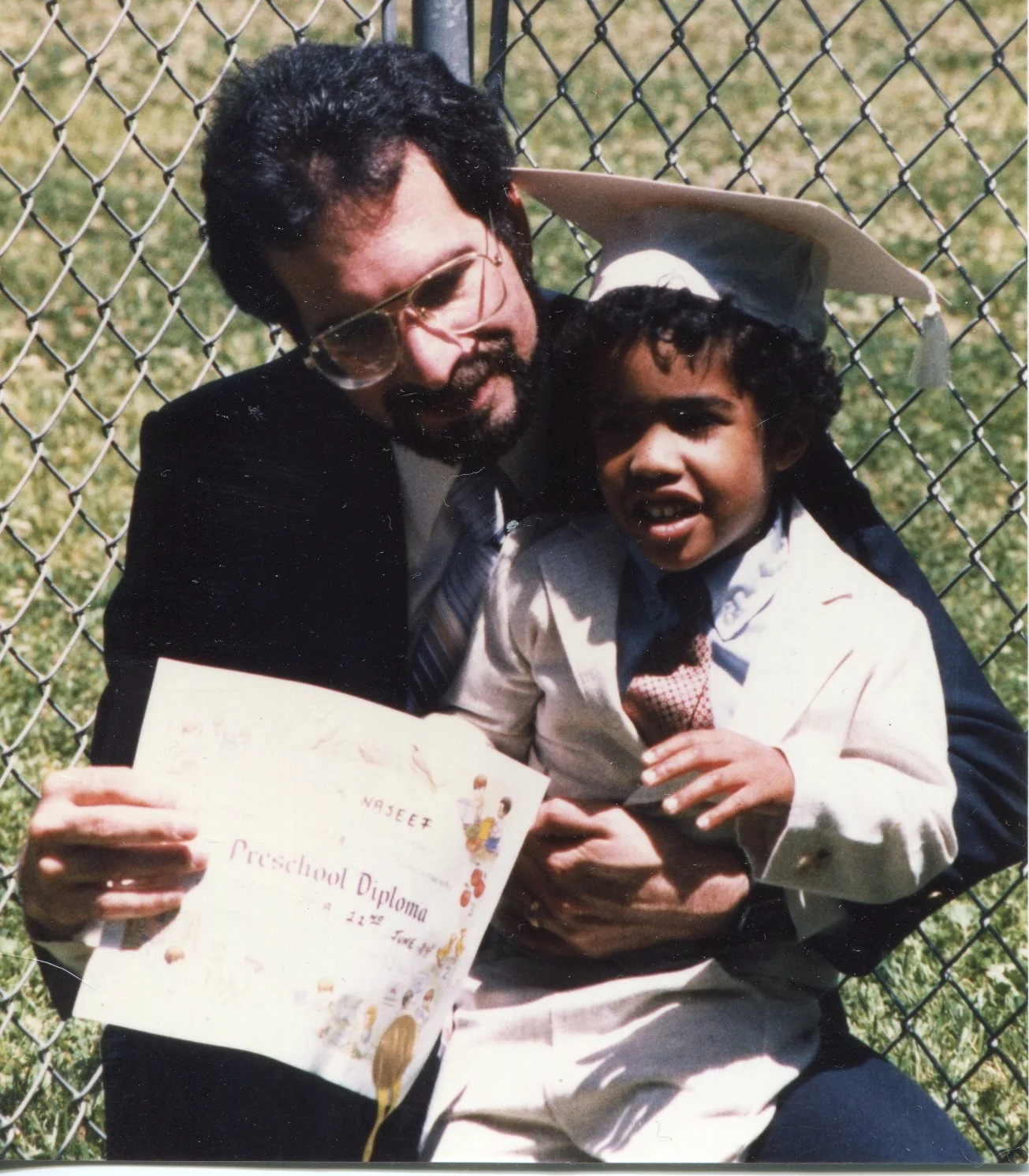
Tariq at age 5 graduation day from ealry intervention, 1984.
My head felt like it was going to explode when my son was diagnosed with autism in the mid-1980s. The diagnosis explained why he was flapping and spinning, but the “A” word stuck in my throat. Some parents have told me they were relieved because they knew something was wrong. Regardless of where one fits on the spectrum of reactions, the mind goes fast forward to the future and can’t help wondering what will happen:
Will these behaviors ever go away?
How well will my child be able to communicate?
Will she live independently?
Can he have an intimate relationship?
What will happen when we are gone?
Since autism is invisible and diagnosed through behavioral observations, it is natural to focus on behavior. It’s natural to imagine that if we can make the behavior go away or at least minimize it, then a child may recover. This article will attempt to provide a perspective on these questions which trouble most parents.
Initially most autism treatment focuses on reducing problem behaviors. This necessary focus can feel like drowning in quicksand. The positive behavior supports approach helps parents and professionals address issues in a relatively new way. Instead of using traditional rewards and punishments, positive behavior supports assumes that all behavior is communication. Parents, teachers, and therapists collaborate to determine what the child is attempting to communicate and teach skills and alternative behaviors to meet the child’s needs.
What we know from recent research
Children with autism grow and mature as we all do; the symptoms may change but rarely disappear completely. Recent research from Deborah Fein and colleagues (2013) shows that a small percentage does move off the spectrum, but these children still show residual problems with attention and anxiety.
Seltzer and colleagues (2000) found a pattern of change from childhood to adolescence and adulthood. 82% improved in communication and social interaction, and 55% showed less repetitive behaviors. They concluded that the symptoms of autism lessen in severity over time and that the best outcomes occur for those with higher IQ scores and better language skills. There is cause for optimism if supported by adequate services in adolescence and adulthood.
Taylor and Seltzer (2010) found overall improvement in autism symptoms and internalized behaviors in young people over a 10 year period. Unfortunately their rates of improvement slowed after leaving school though improvements did seem to continue, just not as much. Those who did not have an intellectual disability had the greatest rates of slowing improvement as well as those with lower family income.
Unfortunately unemployment is high for young adults with autism. Over 80% of those who have an intellectual disability (ID) were in sheltered workshops. Overall only 18% of young adults with ASD without ID were getting some sort of employment or vocational services; even those individuals who were able to find competitive employment tended to have part-time menial jobs. On an upbeat note, the researchers found nearly 50% of youths with ASD without ID are pursuing postsecondary education, so this appears to be a viable option. Currently we do not know whether those degrees translate into a career that is sustainable.
Surviving and Thriving
How do we live with the uncertainty of what the future holds for family and child? How do we handle the next tantrum or meltdown? What about the struggle for services? Here’s the approach that I have developed for myself and that I teach families through my writing, speaking, and counseling:
When you feel the stress take a few slow breaths and notice your reactions: thoughts, feelings, sensations in the body. Like the weather, your unpleasant feelings will pass.
Check out your expectations and adjust if necessary.
As your mind settles a bit, examine your choices to cope in the moment.
Refocus from the behavior to big picture values such as helping your child grow.
Spend some time each day joining your child on the floor or at the table or a screen having fun, following your child’s lead, and building connection.
Your child with autism is still a child and needs more than therapy in her day.
Parents cannot control the outcome for any child, but we can have a full and rewarding relationship with a child growing up with autism.
Facing the Future
Families of children with ASD face an increased challenge at age 21 when services are no longer guaranteed except for those diagnosed with intellectual disability. For a humane society, as well as for the autism community, it is essential to advocate for a meaningful future by extending support and training for individuals with disabilities through adulthood. There is strong scientific evidence that individuals with autism continue to develop in adulthood. With adequate support, it is reasonable to expect continued slow steady progress just as with typically developing adults.
Thus the answers to the questions posed at the beginning of this article will unfold.
References
Fein, D., Barton, M., Eigsti, I.-M., Kelley, E., Naigles, L., Schultz, R. T., Stevens, M., Helt, M., Orinstein, A., Rosenthal, M., Troyb, E. and Tyson, K. (2013), Optimal outcome in individuals with a history of autism. Journal of Child Psychology and Psychiatry, 54: 195–205.
Seltzer, M. M., Krauss, M. W., Orsmond, G. I., & Vestal, C. (2000). Families of adolescents and adults with autism: Uncharted territory. In L. M. Glidden (Ed.), International Review of Research on Mental Retardation, Vol. 23. San Diego: Academic Press.
Taylor, J.L., Seltzer, M.M. (2010). Employment and Post-Secondary Educational Activities for Young Adults with Autism Spectrum Disorders During the Transition to Adulthood. Journal of Autism and Developmental Disorders. 41, (5):566-74.
Click to sign up for Dr. Naseef’s monthly email newsletter.
2 responses to “Has Your Life Ever Felt Like Groundhog Day (Part 2)”
Dawn Lowenstein
Thank you for posting this!
On Wed, Jan 20, 2016 at 4:29 PM, Dr. Robert Naseef wrote:
> Robert Naseef, Ph.D. posted: ” My head felt like it was going to explode > when my son was diagnosed with autism in the mid-1980s. The diagnosis > explained why he was flapping and spinning, but the “A” word stuck in my > throat. Some parents have told me they were relieved because they kn” >